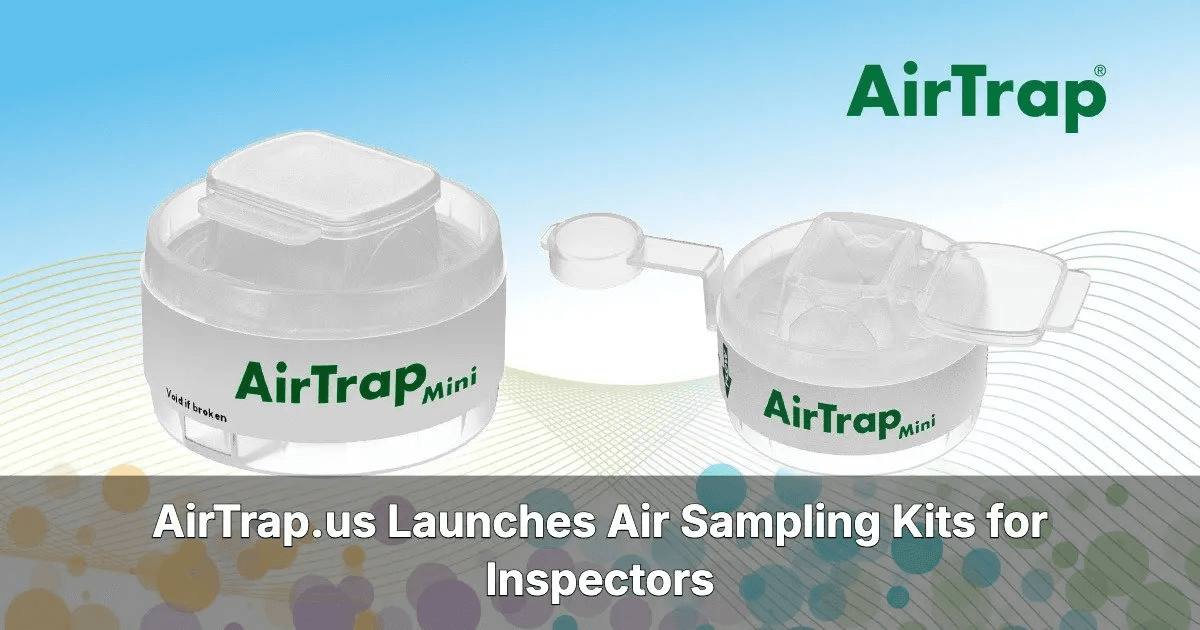
For over thirty years, indoor air quality professionals have relied on spore trap cassettes to collect mold spores and other airborne particles for laboratory analysis. The core cassette design introduced in the mid-1990s remains the standard format for airborne particulate sampling today. AirTrap now introduces a modernized alternative that addresses several limitations of traditional devices while maintaining full compatibility with standard air sampling equipment.
The new AirTrap cassette was developed by Apacor UK in collaboration with Dan Baxter, inventor of the Air-O-Cell cassette, and IAQ expert Jason Earle. The refined design reduces plastic use, improves laboratory analysis clarity, and minimizes handling errors during field collection. This modernization matters because it directly impacts the accuracy and efficiency of mold assessments, which are critical for identifying health risks in homes, schools, and workplaces.
AirTrap launches in North America as an updated alternative to traditional spore trap cassettes, offering improved field usability, clearer laboratory imaging, and a recyclable design. The product is distributed exclusively through AirTrap.us, supporting inspectors, laboratories, restoration professionals, and institutional clients throughout the United States and Canada. The announcement and additional resources are available through the source at Newsworthy.ai.
The implications of this development are significant for the indoor air quality industry. Improved laboratory imaging means more precise identification and quantification of mold spores, leading to better-informed remediation decisions. Reduced handling errors during sample collection increase reliability, while the recyclable design addresses growing environmental concerns about single-use plastic devices. Professionals can adopt this modernized tool without replacing existing air sampling pumps or changing established protocols, lowering the barrier to implementation.
For building occupants, more accurate mold testing translates to better protection against respiratory issues, allergies, and other health problems associated with poor indoor air quality. The sustainability aspect also aligns with broader environmental goals in construction and property management. As mold-related litigation and insurance claims continue to rise, tools that enhance testing accuracy become increasingly important for risk assessment and liability management.
The introduction of AirTrap represents an evolution rather than a revolution in spore trap technology, but its practical improvements could meaningfully advance indoor air quality assessment practices. By addressing usability, analytical clarity, and environmental impact while maintaining backward compatibility, it offers a pragmatic upgrade for professionals committed to accurate and responsible mold testing.