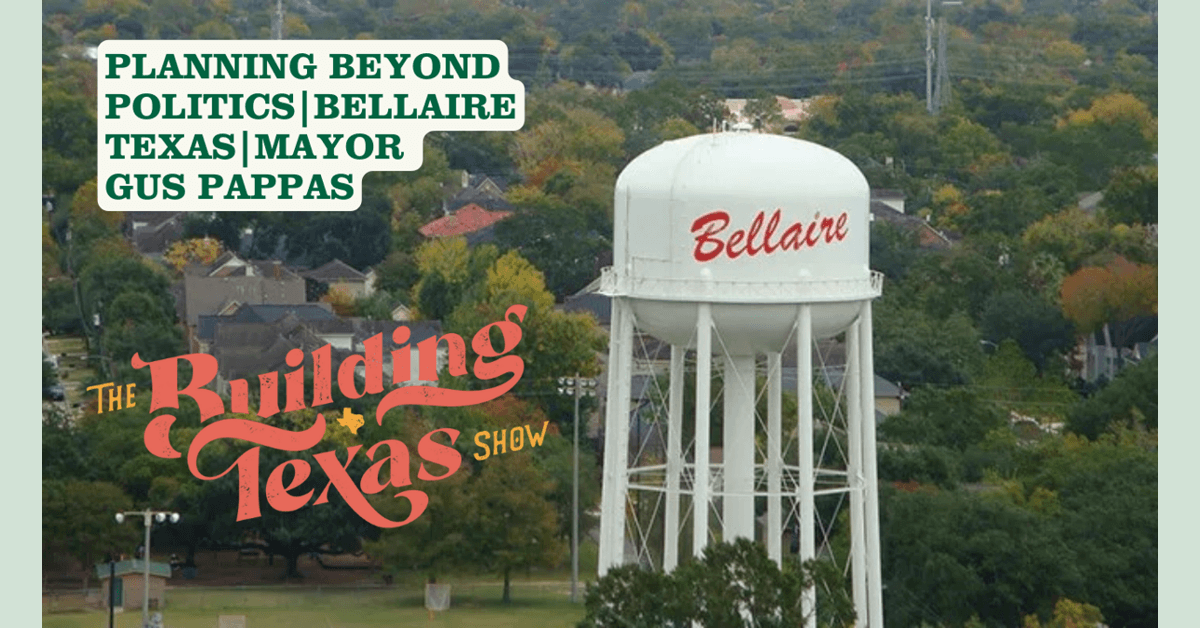
In a recent episode of The Building Texas Show, Bellaire Mayor Gus Pappas provided an in-depth look at the governance principles and infrastructure priorities that define one of the Houston region's most sought-after residential enclaves. The conversation, hosted by Justin McKenzie, moved beyond typical civic discourse to examine the realities of leading a fully built-out city where growth is managed through foresight and preservation rather than expansion.
Mayor Pappas, recently re-elected after eight years on city council, emphasized governance as stewardship rather than political theater. He described the responsibility of making decisions for families, homeowners, and businesses who rely daily on municipal outcomes. Bellaire's model balances elected leadership with professional city management to ensure continuity, transparency, and operational discipline in a city that operates with distinct municipal identity despite being physically inside Houston.
A central focus of the discussion was Bellaire's landmark $110 million regional drainage and flood mitigation initiative, one of the most significant infrastructure investments undertaken by a city of its size in Texas. Born from Hurricane Harvey's lessons, the project represents years of planning and collaboration with the State of Texas, Harris County Flood Control District, the City of Houston, and TxDOT. Mayor Pappas outlined how Bellaire secured state funding, contributed local capital, and coordinated across jurisdictions to address a regional challenge directly impacting property protection and public safety.
This infrastructure investment underscores a core theme of the episode: that unglamorous investments in drainage, detention, and infrastructure are often the most consequential drivers of long-term residential and economic stability. The project, now moving into construction, demonstrates how cities can address climate resilience through coordinated regional approaches.
Unlike most Houston-area cities, Bellaire cannot annex land or expand its boundaries, making growth a matter of reinvestment, redevelopment, and refinement. Mayor Pappas discussed how the city approaches this constraint as an advantage through zoning, land-use planning, and selective redevelopment along established corridors. This allows modernization of infrastructure and enhancement of amenities while maintaining Bellaire's identity as a "city of homes" and protecting neighborhood character.
The episode also highlighted cultural and lifestyle elements defining Bellaire's quality of life, including Evelyn's Park, the Nature Discovery Center, community festivals, outdoor concerts, and the longstanding Fourth of July parade. These shared spaces and civic traditions strengthen social fabric in a community that prioritizes access to Houston's Medical Center, Galleria, Downtown, and cultural venues without urban congestion.
In closing, Mayor Pappas framed Bellaire not as a city chasing rapid growth but as one focused on maturity—investing carefully, protecting its character, and ensuring the next generation inherits a functional community. The full conversation is available on YouTube as part of The Building Texas Show's mission to spotlight Texas cities building deliberately with long-term vision.