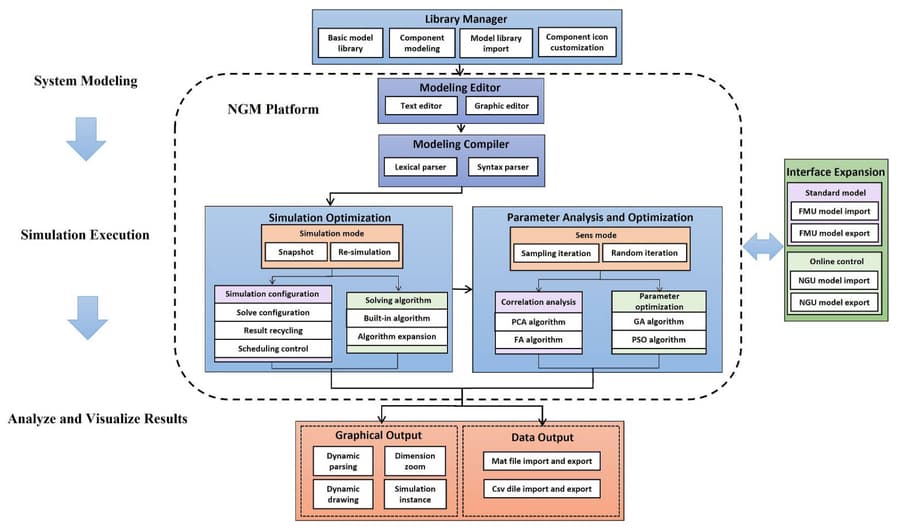
In a significant leap forward for industrial technology, scientists from Zhejiang University have unveiled a revolutionary digital twin (DT) platform that promises to transform the process industry. The Novel Generation Modelling (NGM) system, introduced on September 3, 2024, represents a major advancement in creating highly accurate virtual replicas of physical systems, allowing companies to optimize operations, enhance productivity, and drive innovation in unprecedented ways.
The NGM platform addresses longstanding challenges in digital twin technology by offering a versatile and robust solution capable of seamlessly integrating complex data streams and models from multiple sources. This breakthrough comes at a crucial time as industries increasingly seek to harness data-driven automation and connectivity in the era of Industry 4.0.
At the heart of the NGM system is its use of the open-source programming language Modelica, which provides an intuitive yet powerful modeling environment. The platform features eight integrated modules, including editors, simulators, and compilers, enabling it to model chemical, electrical, thermal, and fluid systems with remarkable accuracy. This comprehensive approach ensures that industrial systems are not only simulated but also optimized for peak performance.
Professor Wenhai Wang, the project's lead researcher, emphasized the significance of this achievement: "Our NGM platform addresses longstanding integration challenges in DT technology. By offering a highly scalable and accurate modeling environment, we empower industries to achieve unprecedented levels of efficiency and reliability." The implications of this technology extend far beyond mere simulation, as it paves the way for safer and more optimized industrial control systems.
The potential impact of the NGM system on various industries is substantial. From chemical plants to energy production facilities, the platform offers the ability to implement predictive maintenance strategies and continuous real-time monitoring. These capabilities can significantly minimize downtime, lower operational costs, and reduce environmental impact. As industries continue to transition into the digital age, technologies like NGM could set new standards for smart manufacturing, making factories safer, greener, and more efficient.
The development of the NGM platform represents not just an incremental improvement but a paradigm shift in industrial automation and control. By enabling predictive analytics and comprehensive scenario simulation, it empowers decision-makers with unprecedented insights into their operations. This level of foresight and control could lead to more agile and responsive industrial processes, better equipped to handle the complexities of modern manufacturing demands.
Furthermore, the NGM system's ability to integrate multi-domain and multi-time scale modeling addresses a critical need in the industry. Complex industrial processes often involve interactions between different physical domains and operate across various timescales. The platform's capability to handle these intricacies in a unified environment is a significant advancement that could lead to more holistic and efficient industrial designs.
As industries grapple with increasing pressure to reduce their environmental footprint, the NGM platform offers a powerful tool for optimization and sustainability. By allowing companies to simulate and refine their processes virtually, it opens up possibilities for reducing waste, improving energy efficiency, and minimizing emissions without the need for costly physical trials.
The introduction of this advanced digital twin technology comes at a time when global industries are facing unprecedented challenges, from supply chain disruptions to increasing regulatory pressures. The NGM platform's ability to provide real-time insights and predictive capabilities could prove invaluable in navigating these complex landscapes, offering a competitive edge to early adopters.
As this technology matures and finds wider adoption, it has the potential to redefine industrial practices across the board. The days of inefficient and error-prone industrial processes may soon be over, replaced by highly optimized, data-driven operations that can adapt in real-time to changing conditions. This shift towards more intelligent and responsive industrial systems could have far-reaching implications for global manufacturing, energy production, and beyond, potentially leading to a new era of industrial efficiency and innovation.