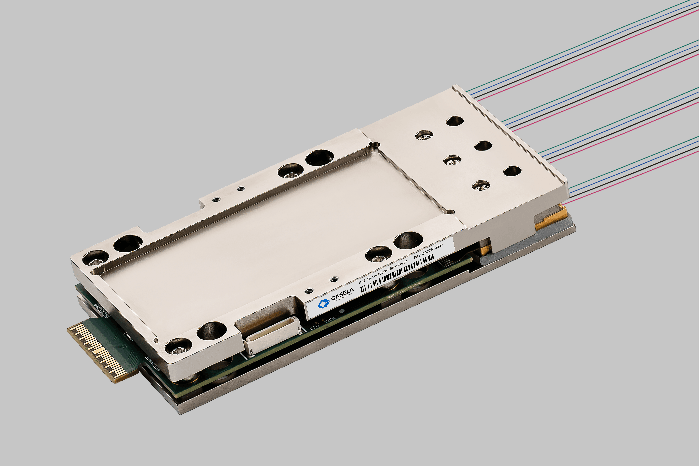
Casela Technologies has launched ELSA-16, a sophisticated external laser source platform engineered to address the escalating computational demands of artificial intelligence and high-performance computing infrastructure. The new platform represents a significant technological advancement in optical interconnect design, offering unprecedented flexibility and scalability for next-generation data center and AI systems.
The ELSA-16 platform integrates 16 high-power Distributed Feedback (DFB) lasers with advanced control electronics in a compact form factor, capable of supporting complex optical networking requirements. With customizable power profiles ranging from 150-200 mW per channel and broad wavelength support including 1310nm and CWDM-4 options, the platform can accommodate diverse technological needs across different computing environments.
A key innovation of ELSA-16 is its ability to enable up to 128 optical channels through a 16 x 8-comb source configuration. This capability represents a significant leap in optical density and communication bandwidth, critical for emerging AI workloads that require massive data transfer capabilities. The platform's design supports dynamic wavelength control and future-ready architecture, positioning it at the forefront of optical interconnect technology.
The platform's significance extends beyond raw technical specifications. As artificial intelligence and machine learning systems become increasingly complex and data-intensive, the demand for more efficient, compact, and high-bandwidth interconnects has become paramount. ELSA-16 addresses these challenges by offering industry-leading wall plug efficiency and precise wavelength control, enabling more compact and power-efficient optical systems.
Industry experts, including Casela's Co-Founder and CTO Milind Gokhale, recognize the platform's potential to transform optical networking. By supporting high-density, parallel optical links, ELSA-16 provides a clear technological pathway for more sophisticated and efficient AI infrastructure.
The announcement comes at a critical moment in technological development, where computational requirements are expanding exponentially. ELSA-16's modular and scalable design suggests a forward-looking approach to meeting these increasing demands, potentially reshaping how high-performance computing systems are architected in the coming years.