

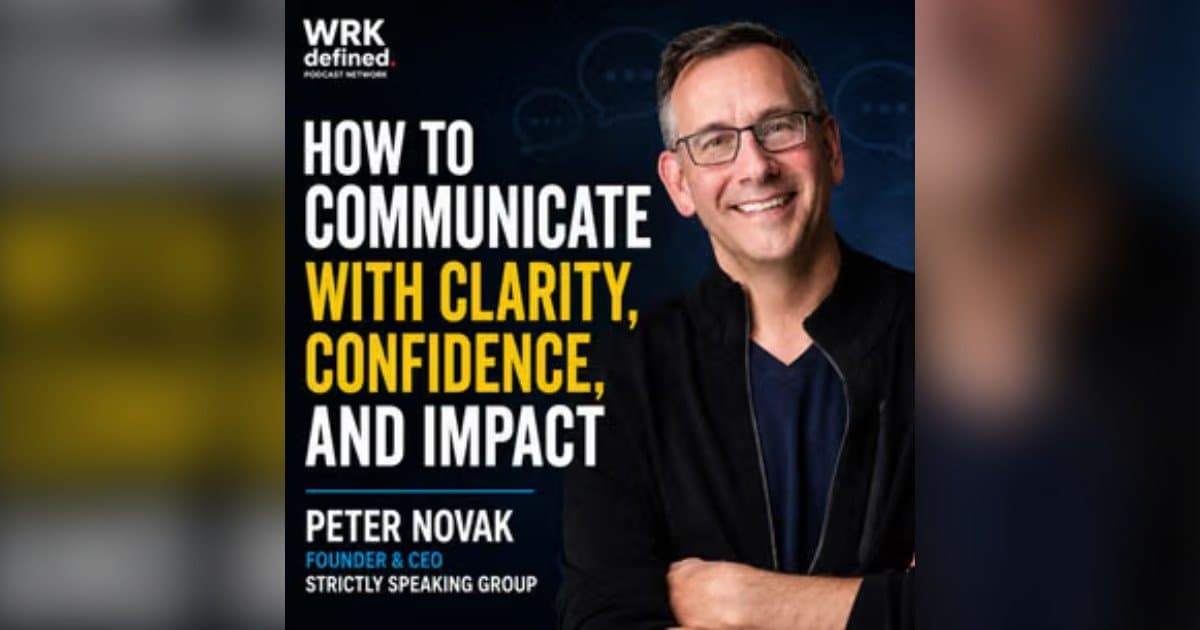
In a world where English dominates global business, the pressure to speak perfectly can undermine effective communication. Peter Novak, founder of Strictly Speaking Group and a former 25-year professor at the University of San Francisco, argues that confidence and clarity matter more than perfect grammar, especially as teams become increasingly global and multilingual.
Novak shared his insights on the You Should Know podcast, produced by WRKdefined. He emphasized that inclusive communication is a business issue, not a political one. "The best way to position it is that this is a business issue, that you need your communication to be as clear as possible to everyone, not just to a select few," Novak said.
One key barrier Novak identifies is the use of phrasal verbs—common in English but confusing for non-native speakers. Phrases like "take off," "take up," "take over," and "take down" can derail understanding. He suggests using AI prompts to replace these with stronger, clearer verbs. This tactic is part of a broader approach to leveling the playing field for non-native English speakers, who often translate and interpret in real time while native speakers barrel ahead.
Novak also highlights unconscious bias, particularly the "like-me bias," which shapes who gets promoted and believed. A McGill University study on foreign accents reveals that accents can affect perceptions of trust and credibility, but confident delivery can overcome these biases. Novak reframes the challenge using a Fred Astaire and Ginger Rogers analogy: "Ginger Rogers did everything Fred Astaire did, only backwards and in high heels." Non-native colleagues, he argues, are doing more cognitive work while native speakers may not realize it.
The conversation also touches on practical tools. Novak describes building executive "voiceprints" by feeding hundreds of hours of transcripts into AI, allowing leaders to deliver scripts that sound authentically like them. He also shares a 20-question intake to help executives communicate their preferences to their teams, from pre-reads to agenda formats. Additionally, investor relations teams now run CEO earnings calls through AI to score language choice and tone of voice, a trend Novak notes is growing.
Cultural intelligence is another theme. Novak notes that Latin American teams often operate trilingually in Spanish, Portuguese, and English until a monolingual American enters the room and collapses the exchange back to English. He draws lessons from his own preparation for business in Tokyo and Dubai, emphasizing the need to adapt communication styles across cultures.
Novak contrasts accessible communication with elitism, referencing Ernest Hemingway's clarity versus Oscar Wilde writing "for about 6 people." The episode is available now wherever podcasts are heard, offering a playbook for leaders navigating global teams. As Novak concludes, the goal is not to dumb down language but to make it universally clear—a skill that directly impacts the bottom line.
