

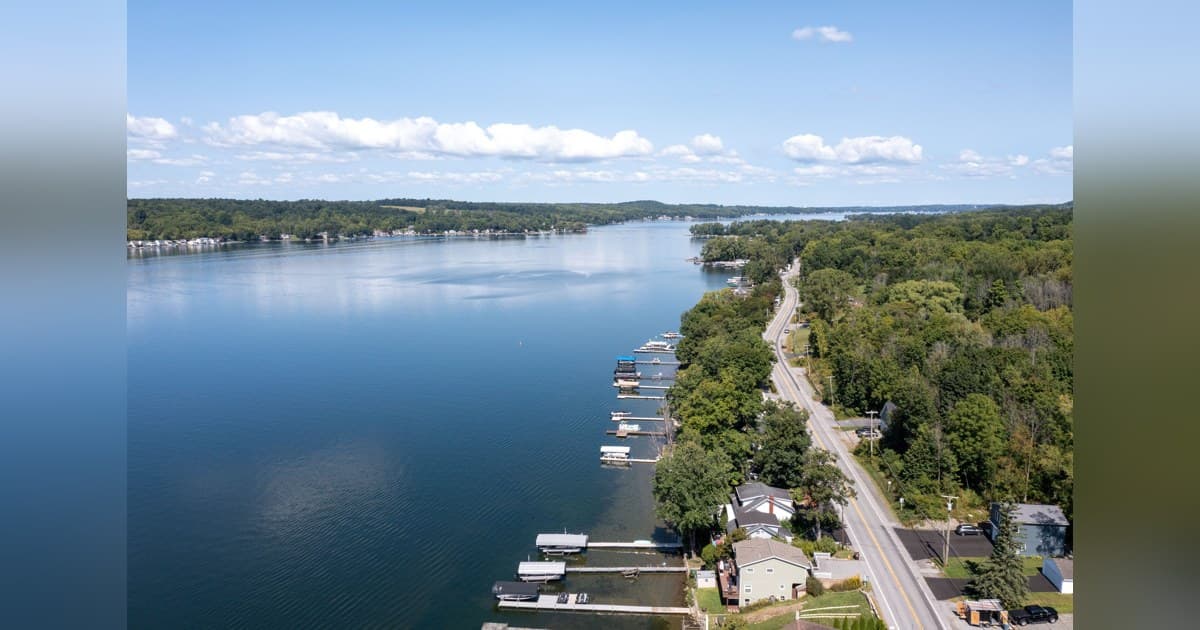
Fifteen waterfront properties closed on Conesus Lake in Livingston County over a recent 90-day period, for a combined total approaching $13 million, with a median sale price around $800,000 and roughly 80 percent of transactions landing between $550,000 and just under $1 million. But according to Matthew Sharman, team leader of The Sharman Team at Real Broker NY LLC, that median figure is the number most likely to be misused by buyers and agents alike.
Sharman, who works the Conesus Lake waterfront market, says agents reach for a round threshold because it is convenient, and that convenience is the problem. "$800,000 is a useful reference point, but it can't be applied across the board," he says. The reason is structural: suburban housing stock supports algorithmic valuation because it is uniform, with comparable lot sizes, square footage and build years. A lake does not work that way. "The lake is its own animal," Sharman says, noting that radius comps fail because properties inside the radius are not comparable to one another. What substitutes for them, he argues, is a sliding-scale adjustment across the variables that actually differentiate one lake property from the next.
The stakes for buyers are considerable. Two Conesus Lake homes at nearly the same asking price can be completely different purchases, because usable frontage, slope and access to the water, water depth, shoreline stabilization, parking, easements and rights-of-way, and the condition of the septic and water systems all change what a buyer is actually getting and what the property will be worth at resale. Sharman's position is that a waterfront property valued without a physical inspection is a property valued on incomplete information. "A lake address is always going to get attention, but the property still has to earn that price," he says.
Beyond the purchase price, Sharman frames three categories buyers should understand before committing: purchase costs, annual carrying costs, and larger replacements likely to arrive later. The carrying list is longer than most first-time lake buyers anticipate, including financing and closing costs, taxes, insurance and utilities, seasonal dock installation and removal with storage, and shoreline maintenance. Insurance warrants early attention, since a conversation about flood coverage may be necessary where financing is involved. Unless a property has been rebuilt or comprehensively renovated, Sharman says it almost certainly carries quirks, as most older cottages around these lakes have been added onto repeatedly across decades.
Sharman identifies one physical characteristic buyers consistently misread: frontage. "Fifty feet of lake frontage doesn't automatically mean fifty feet of usable waterfront," he says. "I've seen modest frontage that gives a family a fantastic lake life, and more frontage that comes with real problems. What matters is how you can actually use it." He also notes that dock quality moves value, particularly at the upper end, contrasting a new aluminum dock with a rickety wooden one.
Where buyers get into difficulty, in Sharman's account, is in assumed costs rather than known ones. "The most expensive mistakes on the lake usually aren't inside the house," he says. "They're at the shoreline, underground, or in the paperwork that says how the property can legally be accessed and used." His practice is to convert assumptions into scope before they become part of an offer, with realistic estimates, contractor input and confirmation of what is permitted. Some of this falls outside a standard home inspection, including breakwall condition, which he says is a mason's work, and sewage ejection systems, which are worth a plumber's eye. "The goal isn't to buy the cheapest house on the lake," Sharman says. "It's to know exactly what you're getting for your money before you sign."
