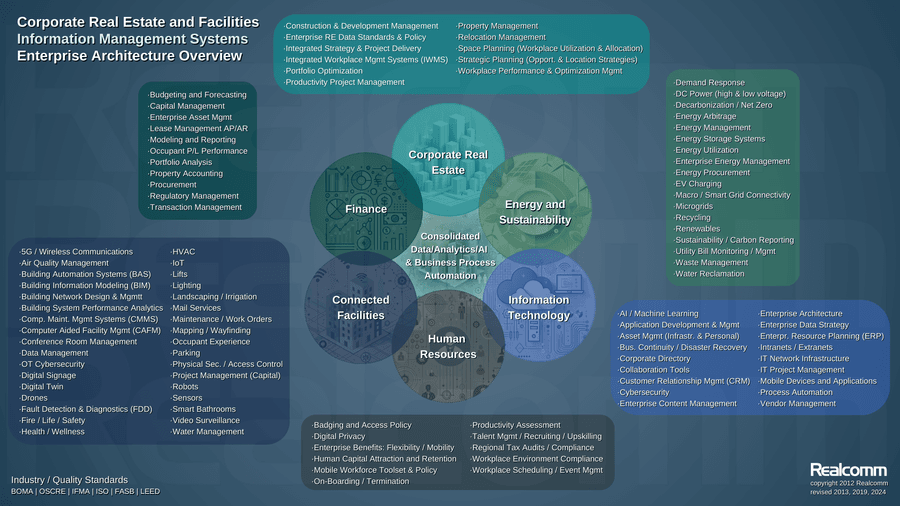
Realcomm Conference Group, LLC has released an updated version of its Corporate Real Estate and Facilities Information Management Systems Enterprise Architecture Overview infographic, revealing that many organizations are still struggling to implement comprehensive approaches to corporate real estate (CRE) and facilities information management. The update, which closely aligns with the original 2012 version, underscores the slow pace of adoption for integrated enterprise architecture in the industry.
The infographic highlights several key aspects that remain largely unchanged since 2012, including a continued focus on fundamental CRE and facilities systems, persistent cross-departmental integration challenges, and the growing importance of data-driven decision-making. Despite significant technological advances in mobility, smart buildings, and data analytics over the past decade, the industry has made limited progress in achieving seamless integration and automation of workflows.
Jim Young, Co-Founder and CEO of Realcomm, emphasized the critical nature of this issue, stating, "The fact that so many elements from our original infographic remain relevant today speaks to the slow adoption of these strategies, even though the potential benefits for integrated and automated workflows are more critical than ever." This lack of progress has significant implications for the industry, as organizations that fail to modernize their CRE and facilities management systems may find themselves at a competitive disadvantage.
The updated infographic reaffirms the opportunity for greater collaboration between departments such as Corporate Real Estate, Connected Facilities, Energy and Sustainability, IT, Finance, and Human Resources. However, the persistence of disparate systems, siloed data, and under-utilization of automation tools continues to hinder progress. This situation presents both challenges and opportunities for CRE professionals and technology providers alike.
The slow adoption of integrated, data-centric methodologies for managing corporate real estate and facilities has far-reaching implications. Organizations that successfully align their systems and data workflows stand to gain significant operational efficiencies, cost savings, and improved decision-making capabilities. Conversely, those that fail to adapt may struggle with inefficiencies, increased costs, and difficulty in making informed strategic decisions about their real estate portfolios.
The updated infographic serves as a call to action for the industry, urging organizations to take proactive steps towards adopting more integrated and automated approaches to CRE and facilities management. As the business landscape continues to evolve, the ability to effectively manage and leverage real estate assets will become increasingly crucial for organizational success.
The implications of this slow progress extend beyond individual organizations to the broader real estate technology sector. The persistent gaps in integration and automation represent significant market opportunities for innovative solutions that can bridge these divides. Technology providers that can effectively address these long-standing challenges may find themselves well-positioned in an industry ripe for transformation.
Realcomm's findings also highlight the need for increased education and collaboration within the industry. The upcoming CoRE Tech 2024 conference, scheduled for November 19-20 in San Jose, will provide a platform for industry professionals to discuss and debate these issues. The event aims to foster innovation and knowledge-sharing, potentially catalyzing more rapid adoption of integrated CRE and facilities management strategies.
As the industry continues to grapple with these challenges, the updated Enterprise Architecture Overview serves as both a reminder of the work that remains to be done and a roadmap for future progress. Organizations that heed this call to action and invest in comprehensive, integrated approaches to CRE and facilities management may find themselves better equipped to navigate the complexities of modern business environments and extract maximum value from their real estate assets.