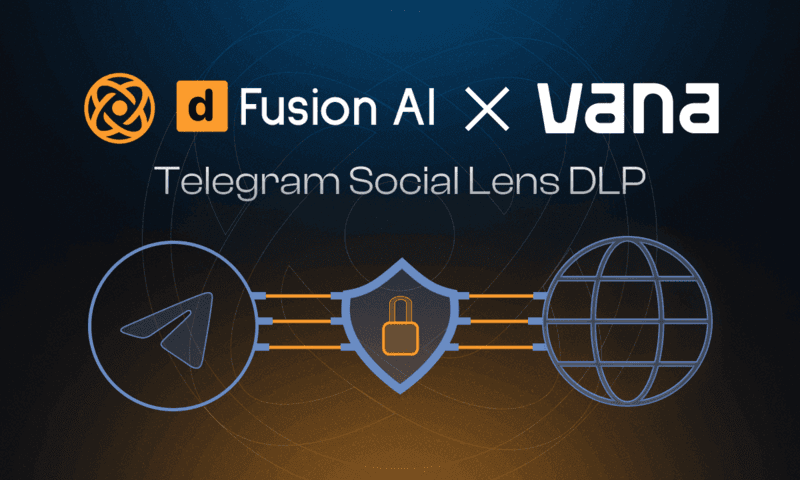
In a significant move towards democratizing data ownership and advancing decentralized artificial intelligence (AI), dFusion AI has partnered with VANA to launch a Private Social Lens Data Liquidity Pool (DLP). This innovative framework is set to revolutionize how conversational data, starting with Telegram messages, is collected, validated, and monetized, potentially reshaping the landscape of AI development and data analytics.
The core of this initiative lies in empowering individuals to reclaim ownership of their private data, a stark contrast to the current model where large tech companies primarily benefit from user-generated content. By allowing users to contribute their Telegram chat data to the DLP, dFusion and VANA are creating a new paradigm where the value generated from personal data flows back to the users themselves.
This development is particularly significant for the AI industry, which relies heavily on vast amounts of high-quality data to train and improve machine learning models. The DLP aims to provide a more diverse, authentic, and ethically sourced dataset for AI training, potentially leading to more accurate and contextually relevant AI models. This could have far-reaching implications for various sectors, from customer service chatbots to advanced language models used in research and development.
The initiative also introduces a novel economic model through its DataDAO structure. Contributors to the DLP will receive $VFSN tokens, which represent ownership in the data pool. When the aggregated data is licensed or sold, the rewards will be distributed directly to the token holders. This creates a direct financial incentive for individuals to participate in the data economy, potentially disrupting the current model where personal data is often harvested without compensation to users.
Furthermore, the DLP addresses critical concerns about data privacy and security. By implementing decentralized data access and ensuring user control over their contributed data, the system aims to mitigate risks associated with centralized data storage and unauthorized access. This approach could set new standards for data handling practices in the tech industry, potentially influencing future regulations and corporate policies.
The launch of this DLP also signals a shift in the power dynamics of the tech industry. By democratizing access to high-quality language data, dFusion and VANA are challenging the monopoly that large tech companies have long held over vast datasets. This could level the playing field for smaller AI companies and researchers, potentially accelerating innovation in the field.
For the broader public, this initiative represents an opportunity to actively participate in and benefit from the AI revolution. Users can now contribute to advancing AI technology while maintaining control over their personal information and potentially earning rewards. This model could foster a more engaged and informed public when it comes to AI development and data usage.
As the project unfolds, it will be crucial to monitor its adoption rate and the quality of data collected. The success of this initiative could pave the way for similar models across other platforms and data types, potentially transforming how we view and value personal data in the digital age.
While the long-term impact of this initiative remains to be seen, it undoubtedly marks a significant step towards a more equitable, transparent, and user-centric data ecosystem. As AI continues to play an increasingly important role in our daily lives, innovations like the Private Social Lens Data Liquidity Pool may prove instrumental in shaping a future where the benefits of AI are more widely and fairly distributed.