

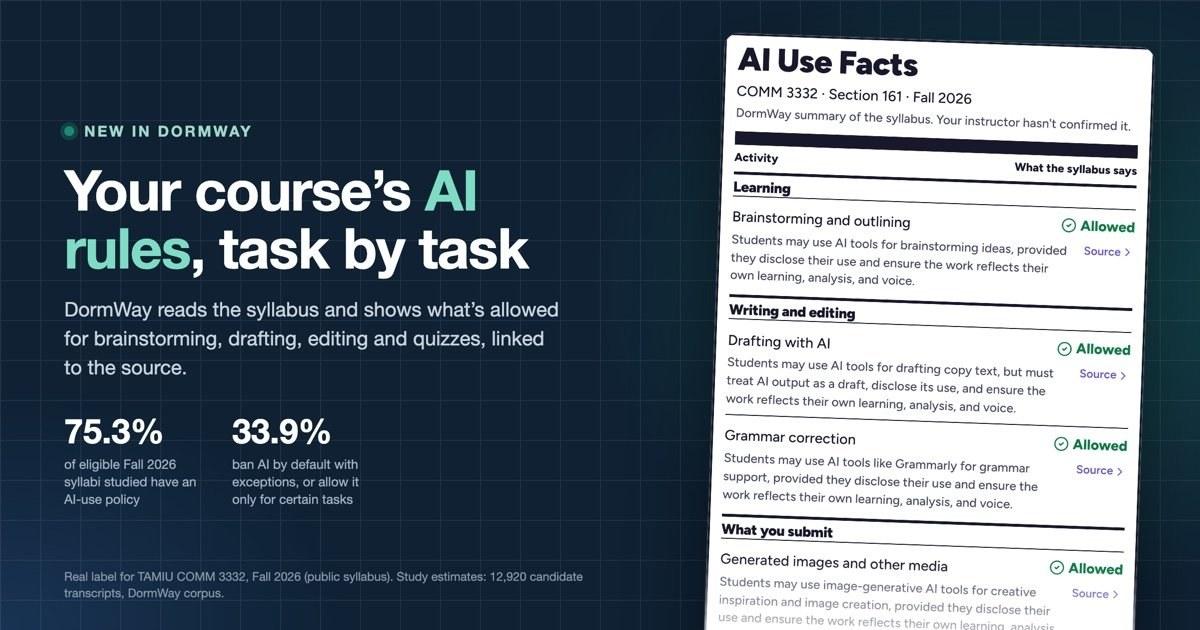
College students often face conflicting rules on artificial intelligence use from one course to the next. DormWay, a student planner that consolidates syllabus deadlines, class schedules, and course policies, has launched a new feature to help students navigate this inconsistency. The Course AI Use Label automatically reads an added syllabus and summarizes task-level AI permissions for studying, brainstorming, editing, generated submissions, and exams, providing links to the syllabus source and any approval and disclosure requirements.
The need for such clarity is underscored by DormWay's analysis of 12,920 candidate Fall 2026 syllabus transcripts. The company estimates that 75.3% of eligible, policy-evaluable documents contain an operative AI-use policy. However, 33.9% rely on default prohibitions or limit permission to specific tasks or assessments, and 11.7% contain mixed or unclear rules. These figures suggest that while many courses address AI, a significant portion leaves students uncertain about what is allowed.
DormWay emphasizes that the label is an automated summary that does not create permission and leaves instructors' instructions authoritative. To further support transparency, the company offers a free label template and a seven-question checklist to help faculty and students document and verify course rules. The full announcement, including downloadable images and bios, is available click here.
This development matters because unclear AI policies can lead to academic misconduct accusations or missed learning opportunities. As AI tools become more integrated into education, students need consistent, accessible information to comply with course requirements. DormWay's label aims to reduce that ambiguity by distilling complex policies into clear, task-specific guidelines. The core organization tools are free, and students can learn more at dormway.app.
The announcement, distributed by Reportable, Inc. and sourced from Newsworthy.ai, highlights a growing effort to bring clarity to AI use in higher education. For students, the impact could be immediate: better understanding of what is permitted in each course, reducing the risk of unintentional violations. For faculty, the free template and checklist offer a way to standardize policy communication. As AI continues to reshape academic work, tools like DormWay's label may become essential for fostering fair and transparent learning environments.
