In cold storage facilities where temperature typically commands attention, moisture has emerged as the primary threat to safety, efficiency, and profitability according to Eldridge, a leading provider of industrial ventilation and dehumidification solutions. Clayton Settle, Project Manager at Eldridge, identified humidity as the silent saboteur in temperature-controlled environments operating between 0°F and 40°F.
Cold storage conditions don't create humidity but amplify existing moisture problems when warm, moist air infiltrates these environments. This creates three significant operational challenges: coil frosting that insulates cooling systems and reduces efficiency, icing and fogging hazards that endanger workers and equipment, and energy waste from frequent defrost cycles and latent heat removal. The dew point, rather than simple temperature readings, determines success in cold storage design according to industry experts.
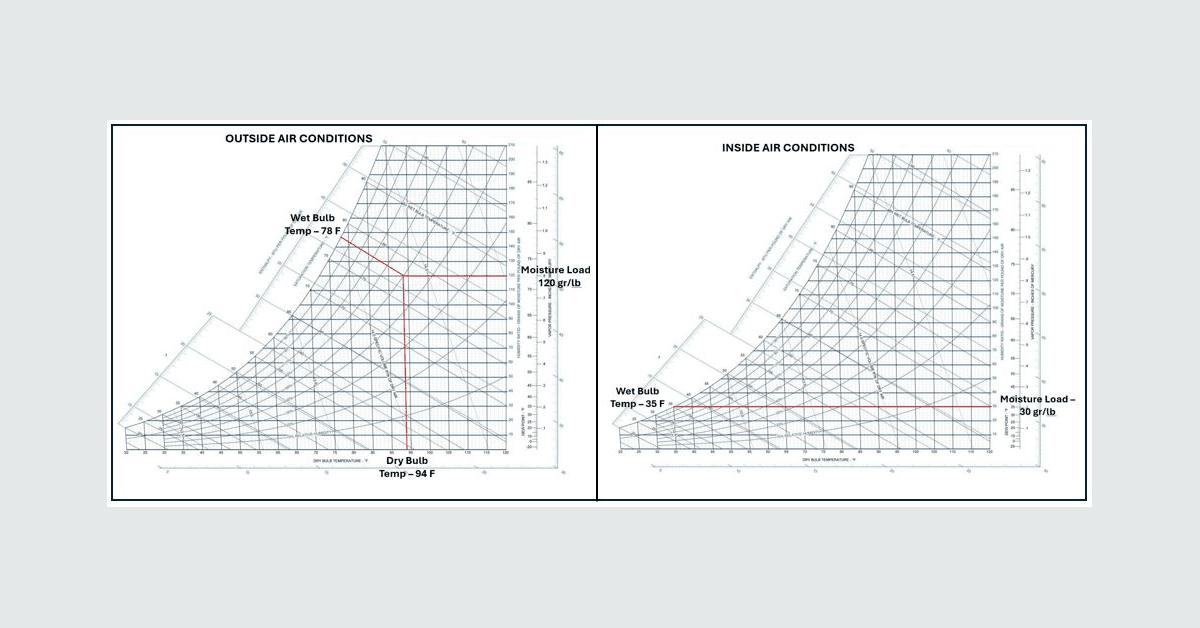
Eldridge engineers are employing psychrometric charts to model and control air's thermodynamic properties, fundamentally changing how industrial facilities manage humidity. By plotting dry-bulb, wet-bulb, and dew point temperatures, engineers can visualize condensation and frost formation points, then design ventilation and dehumidification systems that maintain air safely below its dew point. This approach transforms cold storage management from reactive problem-solving to proactive hazard prevention.
In a practical application documented at https://www.eldridgeusa.com/case-studies, Eldridge modeled outside air conditions of 94°F dry-bulb and 78°F wet-bulb against a 35°F cold storage environment. The resulting 90-grains-per-pound moisture differential enabled precise sizing of desiccant dehumidifiers, preventing frost formation while ensuring safe and energy-efficient operations. This methodology allows facility managers to identify high-risk zones, reduce maintenance cycles, and protect workers before hazards materialize.
The psychrometric approach represents a significant advancement in cold-chain management, moving beyond traditional temperature-focused strategies to address the root cause of many cold storage problems. As industrial facilities increasingly recognize humidity's impact on both safety and operational costs, this engineering precision offers a blueprint for more reliable and economical cold storage operations across multiple sectors including food distribution, pharmaceuticals, and chemical storage.