

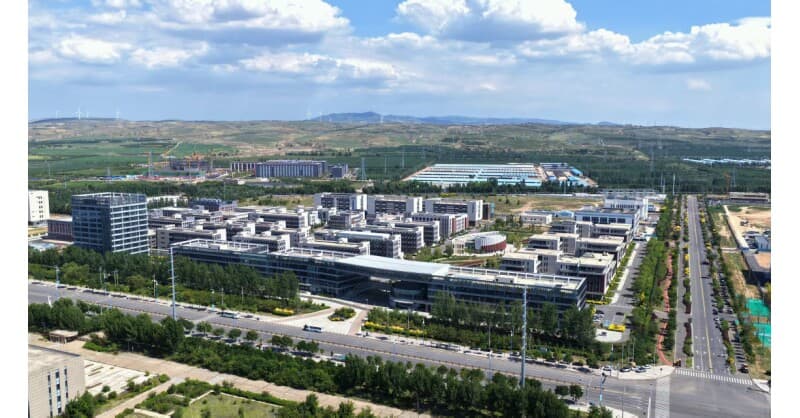
On August 22, 2026, the fourth annual Green Computing Power (Artificial Intelligence) Conference convened on the Cilechuan Grassland in Hohhot, Inner Mongolia, drawing industry leaders and policymakers to address the critical intersection of computing power and energy sustainability. The event, themed "Building Synergy between Computing and Electricity, Exploring New Horizons in Token Economy, and Creating the Future of Artificial Intelligence Together," unveiled the Green Computing Power Development Research Report (2026) and showcased pilots like "millisecond-level urban computing." Major companies, including ByteDance and Cambricon, signed agreements totaling tens of billions of yuan for green intelligent computing centers and token factories.
The conference's location underscores a strategic shift in China's computing industry. Hohhot has become a pivotal hub due to its natural advantages: an average annual temperature of 7°C, over 200 days suitable for free-air cooling, and electricity prices around 0.36 yuan per kilowatt-hour. These factors reduce cooling costs by over 20% and save large-scale GPU clusters about 50 million yuan annually. Currently, Hohhot's total computing capacity reaches 150,000 P, with green electricity usage exceeding 80%.
However, the reliance on wind and solar power poses a significant challenge: their intermittent output clashes with the need for uninterrupted data center operations. To address this, the local "computing-electricity synergy" mechanism integrates a 360,000-kilowatt wind-solar-storage station built by China Huadian Corporation. This facility combines 300,000 kilowatts of wind, 60,000 kilowatts of photovoltaic, and four-hour energy storage. A collaborative control platform dynamically adjusts power allocation based on real-time data, prioritizing storage and flexible tasks during peak green generation, and supplementing with grid power when needed. This transforms the traditional one-way power supply into a bidirectional interactive system.
On the consumption side, innovations minimize waste. The Hohhot data center operated by China Mobile recovers waste heat from nearby power plants for cooling, improving its Power Usage Effectiveness (PUE) from 1.315 to 1.209, saving 560,000 kilowatt-hours annually since operations began. Full operation of two machine halls is projected to save 10 million kilowatt-hours and 150,000 tons of water yearly.
The economic impact is substantial. Electricity costs dominate data center expenses; for instance, the Hohhot Intelligent Computing Center incurred 290 million yuan in 2025, over 70% of its total operating costs. By leveraging local renewable energy and efficiencies, Hohhot is positioning itself as a model for the "East Data West Computing" initiative, which redirects high-demand computing from eastern regions to resource-rich west. The Horinger data center cluster, one of China's top ten, now hosts 62 projects, including data centers for all three major telecom operators, 16 financial institutions, and computing nodes from Huawei, ByteDance, and Kuaishou. Upstream, 45 manufacturers produce servers, cabinets, and sensors locally.
Looking ahead, Hohhot's three-year action plan aims to establish 10 token factories with a daily production capacity of 20 trillion tokens by 2028, enabling customers to procure customized intelligent services rather than just infrastructure. This vision aligns with the conference's theme of exploring new horizons in the token economy. As the prairie winds continue, Hohhot is converting its renewable resources into stable, reliable computing power, demonstrating a scalable model for sustainable AI development that could influence global data center strategies.
