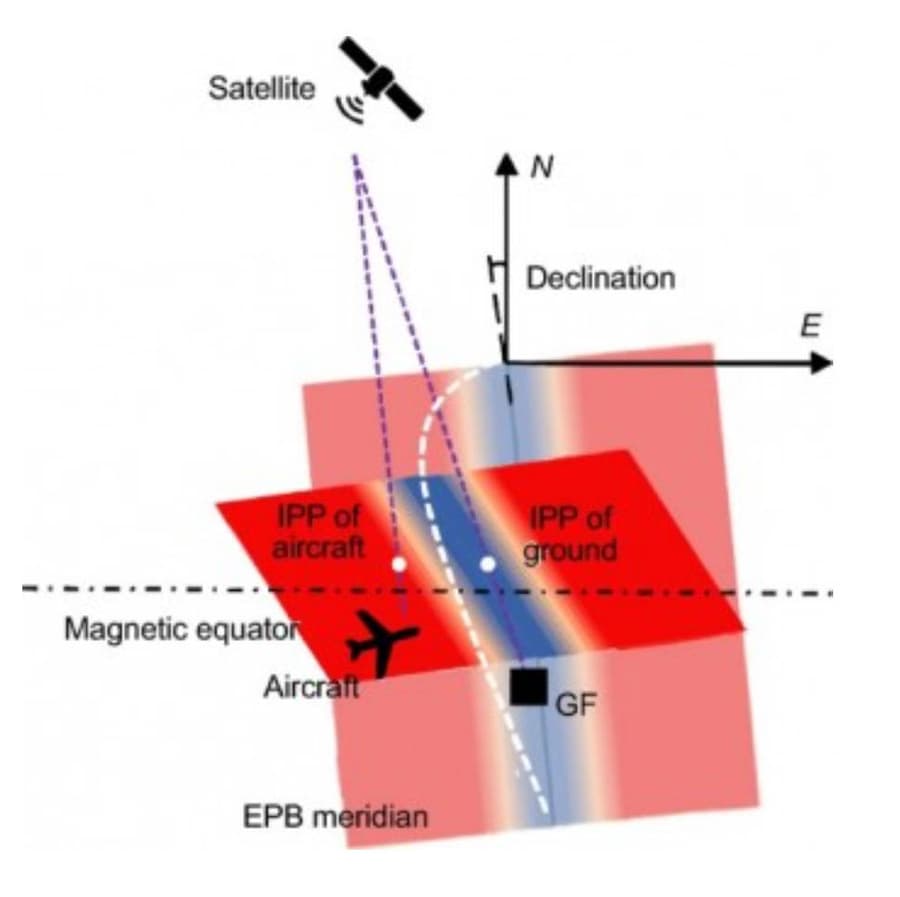
A team of researchers from Hong Kong Polytechnic University has made a significant advancement in aviation safety with a comprehensive study on the effects of equatorial plasma bubbles (EPBs) on satellite navigation systems. The study, published on December 2, 2024, in Satellite Navigation, introduces a novel three-dimensional model to predict the impact of these ionospheric anomalies on Ground-Based Augmentation Systems (GBAS), which are crucial for aircraft precision landing.
EPBs, naturally occurring disturbances in the Earth's ionosphere, have long been a major concern for the aviation sector due to their potential to disrupt satellite-based navigation systems. These disturbances create significant ionospheric gradients, which can lead to Global Positioning System (GPS) inaccuracies, especially during critical flight phases such as landings. With the increasing reliance on GPS technology in aviation, understanding and mitigating the effects of EPBs has become more urgent than ever.
The research team, led by Dr. Yiping Jiang, leveraged data from Hong Kong's Satellite Positioning Reference Station Network to measure the upper limits of spatial gradients caused by EPBs. Their findings reveal that the GBAS is capable of maintaining its integrity even under EPB-induced disruptions. Notably, the study confirms that the system can meet the stringent Category II/III approach requirements, with a very low probability of missed detection of errors induced by critical EPBs.
This breakthrough has significant implications for aviation safety, particularly in low-latitude regions like Hong Kong, where EPBs are more prevalent. The new model provides a comprehensive assessment of the risks posed by EPBs, which is essential for improving the safe operation of GBAS in affected areas. By offering a clearer understanding of how these anomalies affect GBAS, the research paves the way for developing strategies to enhance the safety and reliability of aircraft landing operations worldwide.
The study's findings are particularly crucial given the aviation industry's increasing reliance on satellite-based navigation systems. As air travel continues to grow globally, ensuring the accuracy and reliability of these systems becomes paramount. The research from Hong Kong Polytechnic University demonstrates that with effective monitoring, current GBAS can detect and mitigate potential delays caused by EPBs, ensuring the continued safety and reliability of navigation systems for aircraft.
This research not only addresses a critical safety concern in aviation but also sets the stage for future advancements in the field. The three-dimensional model developed by the team marks a significant improvement over previous two-dimensional approaches, offering a more accurate and comprehensive understanding of EPB effects. This could lead to the development of more robust navigation systems and improved safety protocols in the aviation industry.
The implications of this study extend beyond immediate aviation safety concerns. As the world becomes increasingly reliant on satellite-based technologies for various applications, understanding and mitigating the effects of ionospheric disturbances becomes crucial across multiple sectors. The research from Hong Kong Polytechnic University contributes valuable insights that could be applied to other fields dependent on precise satellite navigation.
As the aviation industry continues to evolve and adapt to new technologies, studies like this play a vital role in ensuring that safety remains at the forefront of these advancements. The work of Dr. Jiang and his team not only enhances our understanding of a complex atmospheric phenomenon but also provides practical solutions to a real-world problem, potentially saving lives and improving the reliability of air travel worldwide.