

Businesses under 200 employees typically run about 42 separate applications, forcing managers to juggle multiple logins and copy-paste data between systems for even simple tasks like converting a prospect or sending an onboarding agreement. This fragmentation, which idhubs calls the integration tax, is no longer just an annoyance—it's a barrier to leveraging artificial intelligence effectively, according to a recent interview with idhubs leaders on The Building Texas Show.
Rojit Sorokhaibam, Founder and CEO/CTO of idhubs, and Brandon Fears, Chief Growth Officer, spoke with host Justin Mackenzie about why the traditional software stack breaks under AI. "When AI was a chatbot, siloed data was an annoyance. Now that AI is becoming an agent that executes multi-step work, siloed data is a wall," Sorokhaibam said. "An agent cannot intelligently complete a workflow if it has to reach across five databases that only pretend to talk through brittle webhooks." He calls this context blindness, arguing that true intelligence requires one data foundation that cannot be bolted on after the fact.
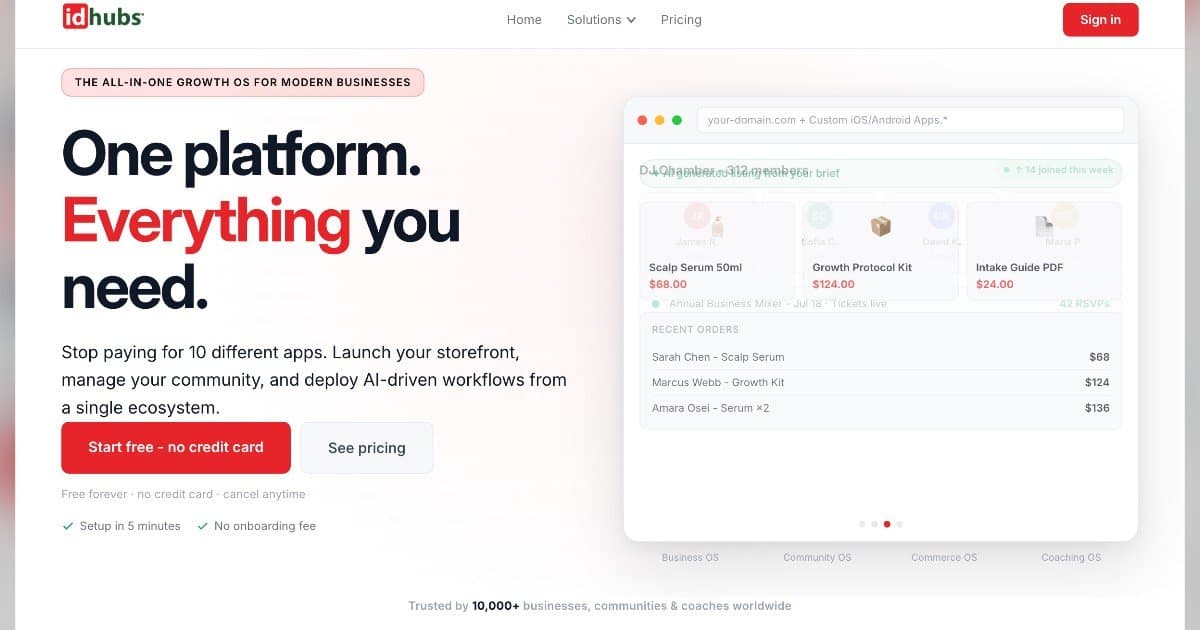
idhubs offers a natively unified operating system that replaces the stack rather than adding to it. Core functions—CRM, e-commerce, community, invoicing, and AI—run on a single shared data layer. This architecture enables AI agents to execute complex workflows natively. For example, in customer success, an AI agent can read a complaint in a community forum, pull billing history from the unified invoicing module, identify a double-charge, auto-draft a credit memo, and route it for approval—all without human intervention.
Security concerns about a single point of failure are addressed through a permissioned, private Hyperledger Fabric network. "Fabric uses channels and private data collections, so sensitive records are visible only to the nodes that are cryptographically authorized to see them," Sorokhaibam explained. This provides decentralization and immutability without the resource intensity of public blockchains, using off-chain storage for large files and asynchronous operation to avoid latency.
The company also offers a white-label community and social commerce layer, allowing organizations to own their audience and data. "When you build your community on a third-party social platform, you rent your audience; you don't own the data, you don't control the algorithm and you can't monetize without a cut taken off the top," Fears said. With idhubs, community data lives natively beside CRM and commerce data, creating a closed loop where discussions can become transactions or support tickets.
idhubs targets a total addressable market of roughly $158 billion and has acquired over 50,000 registered users organically, with no paid marketing. Pricing is a flat, predictable annual rate based on organizational capacity and transactional volume, not headcount. Automated migration pipelines for incumbents like HubSpot, QuickBooks, Salesforce, and Slack aim to reduce switching costs.
As AI becomes more agentic, the need for a unified data foundation will only grow. idhubs is betting that its native architecture will win against legacy suites that were built as separate apps glued together. For more information, visit idhubs.
