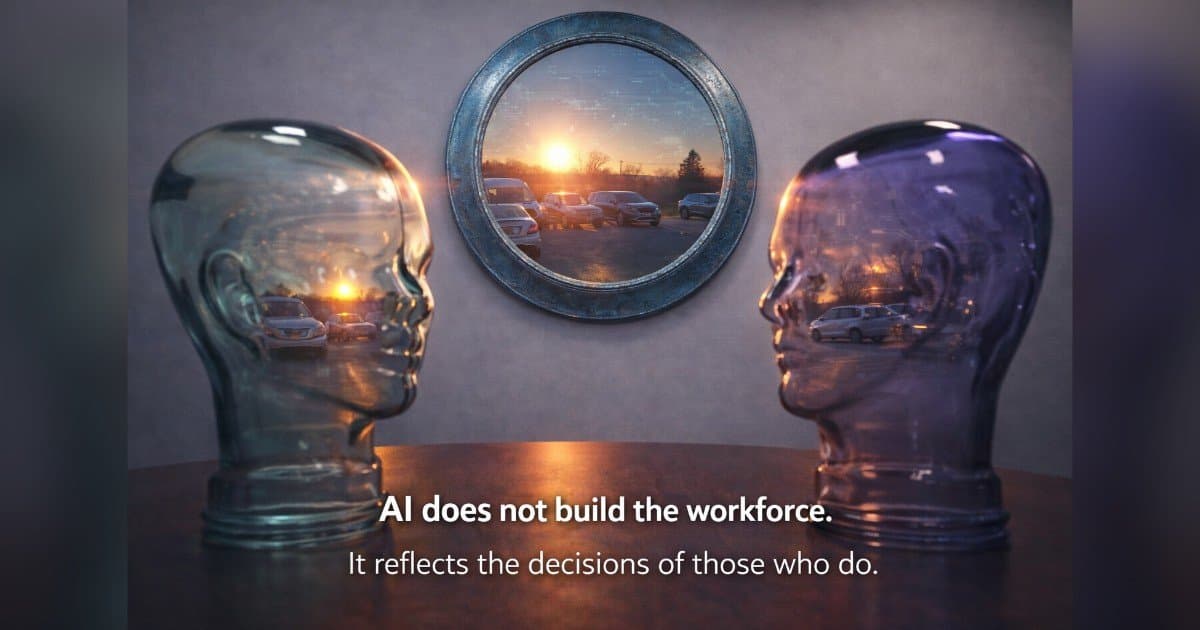
The integration of artificial intelligence into industrial environments does not eliminate the need for human workers but instead elevates the importance of human cognition, contextual judgment, and domain-specific expertise. Industrial STEM education has become essential for preparing leaders and skilled professionals who can interpret data, apply technology effectively, and build workforce pipelines for emerging industries.
Today's advancements in measuring industrial effectiveness and efficiency demand more than technology alone. They require the science, application, and mechanics unique to specific industrial sectors to realize the true value of AI. Data alone does not produce outcomes, and artificial intelligence alone does not produce progress. The bridge between potential and performance remains something that cannot be manufactured artificially: human cognitive thought.
Consider the everyday example of automotive tires with projected lifecycle warranties. Historically, proving whether tires failed to meet published mileage projections required significant effort involving weeks of data collection, technical expertise, and expensive equipment. Modern systems can now capture variables automatically through sensors, onboard diagnostics, and intelligent analysis tools. Yet the thinking required to use these tools has not disappeared, highlighting that AI operates as an amplifier of human capability rather than a replacement.
Much of today's conversation around artificial intelligence centers on fear about job replacement, but this perspective misses the deeper reality operating inside industrial environments. AI has no understanding of welding tolerances, machining variances, maintenance behavior patterns, process flow bottlenecks, or safety culture. While AI can analyze patterns at extraordinary speed and detect anomalies human eyes might overlook, it cannot independently understand context without human guidance. The tooling of AI requires one component that cannot be generated artificially: the cognitive thought of a human.
In industrial settings, context is everything. A sensor reading is not insight, a dashboard is not understanding, and an algorithm is not experience. Human expertise transforms information into purposeful meaning. This is where Industrial STEM finds its true significance as the integration of technical knowledge with applied industrial practice, the real-world mechanics, constraints, and problem-solving required to turn theory into production.
Consider the difference between knowing how data works and understanding why data matters in a manufacturing environment. A data analyst may recognize an anomaly pattern, while a machinist or maintenance technician understands whether that anomaly represents tool wear, material inconsistency, operator variation, or environmental influence. Without industrial context, data remains incomplete. AI, no matter how advanced, relies on domain-specific understanding to produce meaningful outcomes, with its effectiveness directly tied to human ability to translate industrial science into usable parameters.
For decades, industrial progress has been built on measurement of cycle times, defects, uptime, productivity, efficiency, and quality. What has changed is not the importance of measurement, but the speed and scale at which measurement now occurs. Before modern data systems, measurement was reactive with problems discovered after failure occurred. Today, predictive and preventive models allow industries to anticipate challenges before they happen, but predictive capability introduces a new demand: interpretation. A prediction is only valuable if someone knows what to do with it, requiring industrial professionals to become translators between AI outputs and operational reality.
Industrial environments have always required strong technical leadership, but the rise of AI introduces a new layer: interpretive leadership. Leaders must now understand both the technology and the human systems around it, asking whether recommendations align with operational realities, if they're solving the right problems, what consequences decisions might create downstream, and how to help workers trust and understand AI-driven insights. AI cannot answer these questions—only humans grounded in experience, ethics, and contextual understanding can make these judgments.
The narrative that AI will replace people oversimplifies the challenge, as history has shown technological advancements rarely eliminate work but instead transform its nature. In industrial sectors, AI increases demand for workers who possess technical literacy, systems thinking, applied problem-solving, interdisciplinary understanding, and decision-making grounded in context. The worker of the future is not replaced by AI but empowered by it, though only if properly prepared. The real risk is not AI replacing humans but failing to prepare humans to use AI effectively, as discussed in Dr. Johnson's article on Workforce Education.
Educational institutions, industry leaders, and workforce development partners face a critical decision point between training individuals to use technology versus developing thinkers who understand how technology fits inside real industrial systems. Teaching software use alone creates operators, while teaching industrial science, application, and mechanics creates leaders. As AI continues to expand, the value of industrial experience rises rather than falls, with the ability to connect data to physical processes becoming the competitive advantage.
The future of industry will be defined by collaboration between human cognition and intelligent tools, with AI monitoring equipment health in real time while skilled professionals interpret recommendations and leaders make decisions balancing efficiency with safety and quality. This future depends on one factor that cannot be automated: human understanding. As industrial systems become more advanced, the industries that thrive will recognize that AI is a tool, not the workforce, with human cognition remaining the anchor that gives meaning to information.