

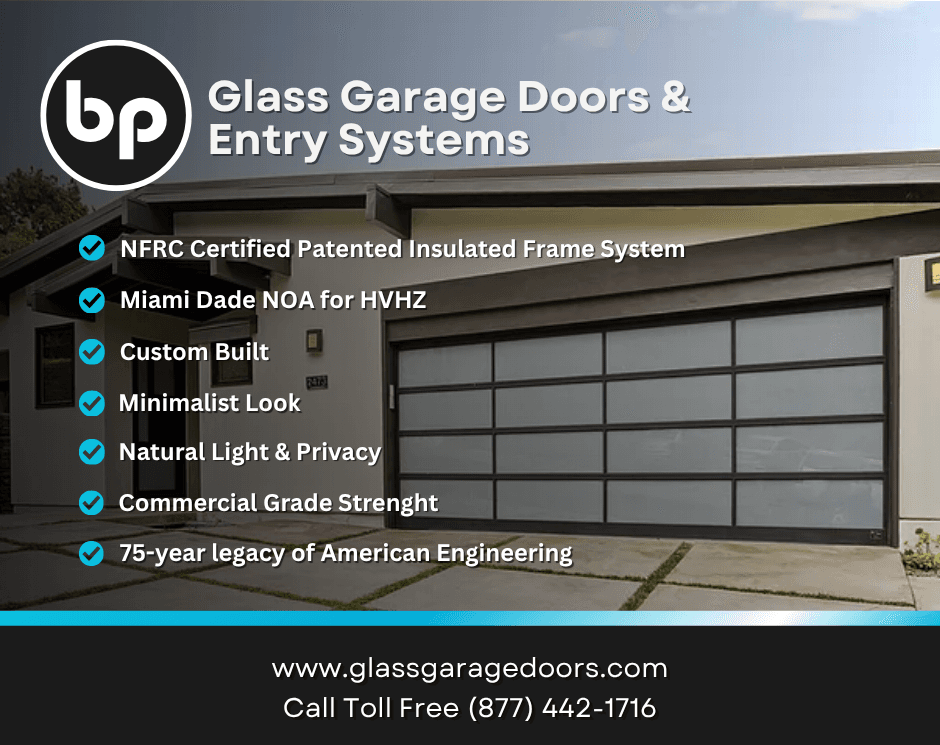
As the demand for seamless indoor-outdoor living spaces grows, a new industry advisory from bp Glass Garage Doors & Entry Systems is drawing attention to the potential dangers of frameless glass garage doors. The advisory, released August 5, 2026, warns that these aesthetically popular systems may pose significant safety, structural, and code compliance risks, particularly in coastal and high-wind regions.
Frameless glass garage doors typically rely on chemical adhesives, double-sided tapes, or caulking to bond heavy glass panels to hidden frames. Unlike interior installations, exterior doors are exposed to thermal expansion, UV radiation, and weathering, which can degrade these chemical bonds over time. This degradation creates a risk of panel detachment and envelope failure, leading to property damage and safety hazards. Rob Reyes, General Manager of bp Glass Garage Doors, emphasized, "Adhesive-bonded frameless glass doors present a liability for commercial spaces and homeowners alike. In an overhead application, relying on glue to support heavy glass panels over years of operation poses real dangers."
The advisory also outlines several design limitations and code failures inherent to frameless systems. To hide the interior framework, these doors often require dark gray or mirrored glass, which can compromise the seamless aesthetic under certain lighting conditions. More critically, adhesive frameless configurations lack verified thermal breaks and independent laboratory testing, causing them to fail strict municipal building codes, energy standards like California Title 24, and NFRC requirements. This can lead to failed building audits, denied permits, and forced removal in some jurisdictions.
In hurricane-prone areas, the risks escalate. The advisory specifically calls out High-Velocity Hurricane Zones (HVHZ) such as Miami-Dade and Broward counties, where frameless doors are prone to accelerated adhesive degradation due to extreme heat, humidity, and salt air. These systems also lack mechanical retention, making them vulnerable to blowout under high winds and missile impacts during storms. Furthermore, they lack official Florida Product Approval (FPA) and Miami-Dade County Notice of Acceptance (NOA), making installation non-compliant and potentially voiding insurance claims. Reyes added, "True storm protection requires a high structural performance system that is mechanically anchored and impact-tested."
Maintenance challenges also arise, as proprietary hardware configurations often complicate glass replacement and component sourcing. In contrast, bp Glass Garage Doors offers an alternative: engineered frames that provide the narrowest profiles without compromising safety. Their systems mechanically secure glass panels within custom frames and are independently tested and NFRC certified, making them suitable for sensitive live/work environments. With a 75-year manufacturing heritage, bp promotes factory-direct models backed by warranties.
This advisory serves as a critical reminder for architects, contractors, and property owners to weigh long-term durability against visual trends. As building codes tighten and climate events intensify, the choice between adhesive and mechanically anchored systems carries far-reaching implications for safety, liability, and compliance. For those considering frameless glass doors, a thorough evaluation of structural integrity and code adherence is essential.
