

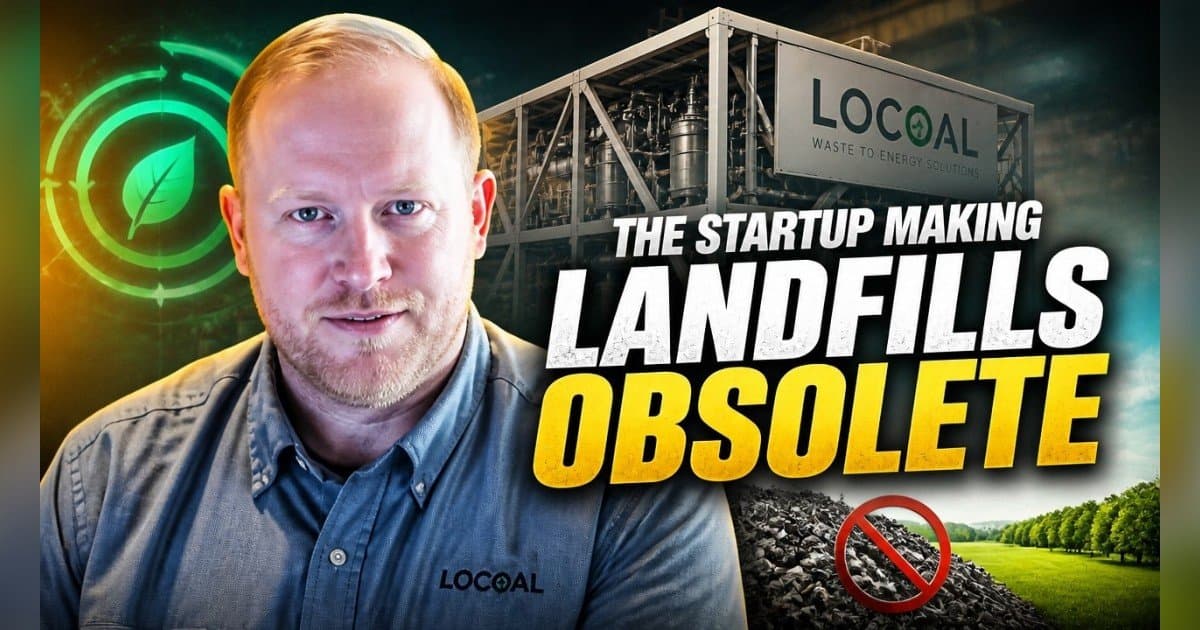
LOCOAL co-founder and CEO Miles Murray made a direct appeal to Texas county judges on a December 2025 episode of The Building Texas Show, telling local officials they should consider turning problematic waste piles into power. The pitch comes as mulch, storm debris, and old tires accumulate at sites across the state, often out of public view and posing significant fire risks.
Murray explained that many of these piles sit a couple of miles off the interstate, where the mulch market is nearly saturated, leaving material to sit for long stretches. In dry seasons, he warned, those piles become fire hazards that can accelerate large wildfires. The Houston Fire Department’s fire safety standard for wood waste processors supports that concern, stating that wood chipping, hogging, composting, and mulching operations “create a significant fire hazard and are rated as a very high hazard.”
LOCOAL’s waste-to-energy system was developed with support from the U.S. Air Force through the federal Small Business Innovation Research (SBIR) program. Federal SBIR records list Air Force Phase I and Phase II awards to the company, which describes itself as seed-funded by an AFWERX contract. Murray said the technology is nearing a phase three designation, which would allow federal entities to procure it directly.
The company’s first commercial unit is installed in Houston. It uses pyrolysis—heating wood waste without oxygen—to produce electricity and a high-purity carbon product, and Murray said LOCOAL is also moving into rubber from tires. The system is built for mobility: a 50-foot module that can be transported on eight flatbed trucks and set up in a couple of weeks. Each system can process about 50 tons of material per day.
Murray framed the technology as a way to make landfills obsolete and turn waste disposal costs into revenue streams. He also addressed skepticism about carbon markets, arguing that LOCOAL tracks carbon from the waste’s origin to its end use, unlike projects measured from a helicopter over the Amazon.
The conversation marks Murray’s third appearance on The Building Texas Show, following episodes in 2023 and 2024. County leaders, fire officials, and anyone managing a waste pile can learn more at www.buildingtexasshow.com.
For Texas counties, the pitch arrives at a critical moment. With mulch markets saturated and wildfire risks mounting, officials face limited options for managing woody waste. LOCOAL’s mobile pyrolysis units could offer a practical alternative that reduces fire hazards, diverts material from landfills, and generates electricity—potentially transforming a liability into an asset. As Murray told host Justin McKenzie, “If you’re a county judge somewhere in Texas that wants to be innovative and get rid of your mulch, get rid of your tires… this is a product that you should be thinking about.”
