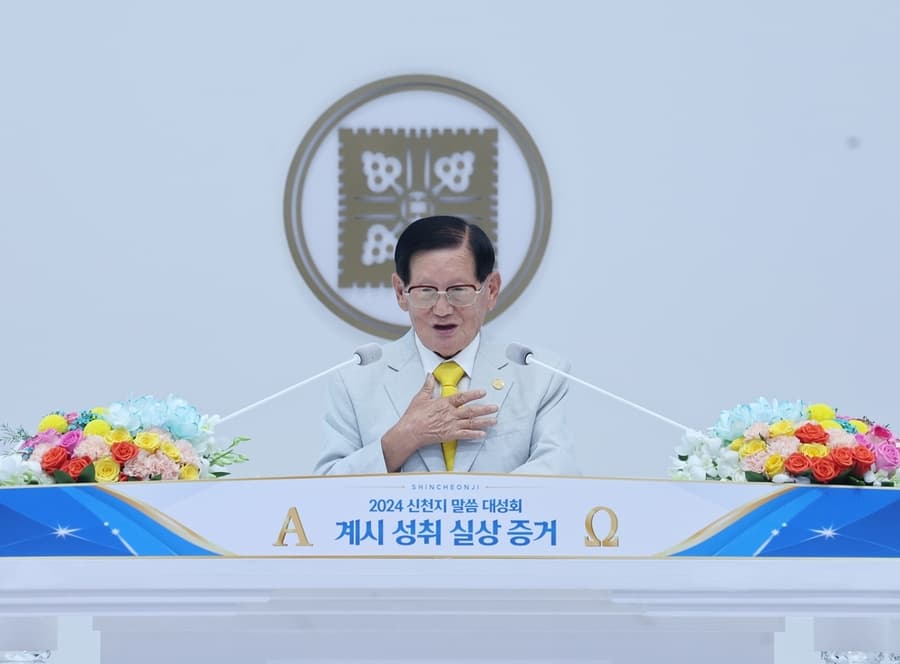
In a remarkable display of religious fervor, more than 70,000 people converged on Busan, South Korea, for the 2024 Shincheonji Word Crusade, an event focused on exploring the fulfillment of biblical prophecies. The gathering, held at the Andre Training Center on September 29, 2024, marks a significant moment in South Korea's religious landscape, potentially reshaping the future of Christian unity and biblical interpretation in the country.
The crusade, organized by the Shincheonji Church of Jesus, Temple of the Tabernacle of the Testimony, under the leadership of Chairman Man-hee Lee, came in response to requests from pastors and believers in the Yeongnam region. This event is part of a national traveling crusade that has been ongoing since the church's founding in 1984, consistently drawing believers from across the country.
Chairman Lee, serving as the main lecturer, emphasized the importance of aligning faith with biblical teachings and understanding the true meaning of the Word. He stated, "The solid foundation for verifying these words is 'reality.' We must examine each prophecy for its fulfillment. When the time comes, the truths of the Book of Revelation will surely manifest." This focus on the practical application and verification of biblical prophecies represents a distinctive approach to religious study and interpretation.
The event's impact extends beyond its immediate participants, with live broadcasts on YouTube garnering over 73,300 views. This digital reach significantly amplifies the crusade's message, potentially influencing a broader audience beyond those physically present. The crusade's ability to engage such a large audience, both in-person and online, suggests a growing interest in deeper biblical understanding and prophetic interpretation among Christians in South Korea and potentially worldwide.
One of the most notable aspects of the crusade is its role in fostering unity among different Christian denominations. As of last month, 727 domestic churches have signed memorandums of understanding (MOUs) with Shincheonji Church of Jesus, and internationally, 13,053 churches across 84 countries have joined in this mission. Furthermore, a total of 1,671 churches in 43 countries have changed their signs to align with Shincheonji. This level of inter-denominational cooperation is unprecedented and could signal a new era of religious unity and collaboration.
The event's success and its message of unity come at a crucial time for South Korea's Christian community. Pastor Hwang from an independent denomination noted, "Currently, 70% of churches in Korea lack Sunday schools. For the Korean church to flourish, the truth of God's Word must come alive." This statement highlights the challenges facing many Korean churches and positions the Shincheonji Church's approach as a potential solution for revitalizing faith communities.
The crusade's impact on individual pastors and believers is equally significant. Many attendees expressed a renewed passion for biblical study and a desire to share their experiences with others. This enthusiasm could lead to a ripple effect of increased biblical engagement and spiritual renewal across various congregations.
As South Korea continues to be a major hub of Christianity in Asia, events like the Shincheonji Word Crusade have the potential to influence religious trends not just nationally, but across the region. The emphasis on biblical prophecy and its fulfillment, combined with a call for church unity, presents a unique theological perspective that could shape discussions on faith and scripture interpretation for years to come.
While the long-term effects of this crusade remain to be seen, its immediate impact on attendance, inter-church cooperation, and individual spiritual enthusiasm is clear. As religious landscapes continue to evolve globally, events like this serve as important indicators of shifting trends in faith, community, and biblical interpretation. The Shincheonji Word Crusade in Busan may well be remembered as a pivotal moment in South Korea's religious history, potentially setting the stage for a new era of Christian unity and biblical engagement.