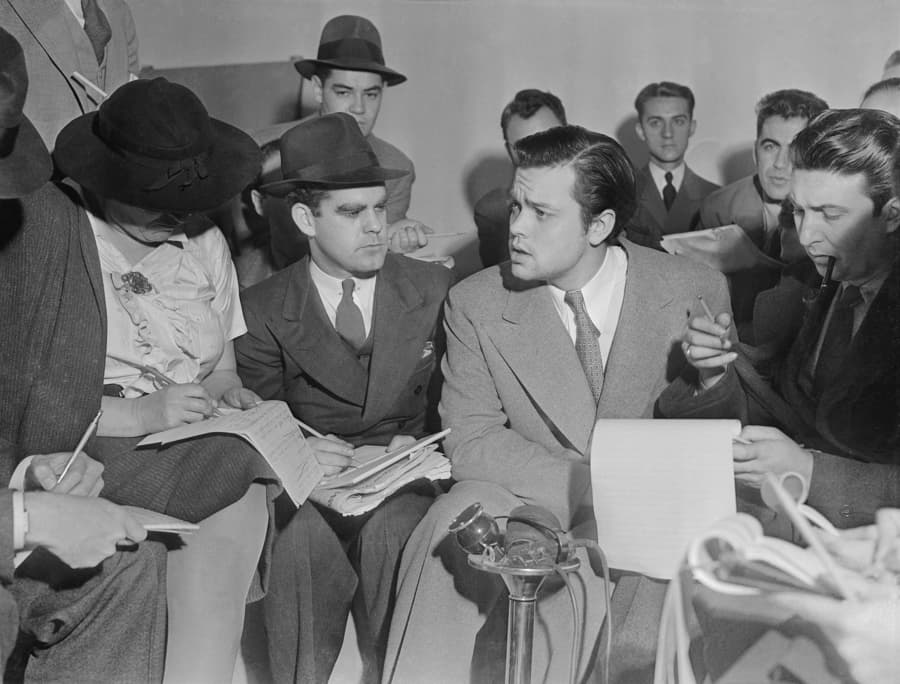
A recently published book detailing the infamous 1938 'War of the Worlds' radio broadcast has taken on unexpected relevance in light of recent UFO sightings in New Jersey. 'Dead Air: The Night Orson Welles Terrified America,' by William Elliott Hazelgrove, explores the mass panic caused by a fictional alien invasion broadcast, drawing striking parallels to current events and public reactions.
The book, released on November 19 by Rowman and Littlefield, recounts the events of October 30, 1938, when Orson Welles broadcast a radio adaptation of H.G. Wells' 'The War of the Worlds.' The realistic portrayal of a Martian invasion in Grover's Mill, New Jersey, sparked widespread panic across the United States, resulting in reported deaths, heart attacks, and accidents as people fled in terror.
Hazelgrove's work has gained critical acclaim from major publications such as The Associated Press, Wall Street Journal, and Publishers Weekly. Its release coincides with a series of unexplained UFO sightings in New Jersey over the past week, which have ignited intense speculation and theories on social media platforms.
The author draws attention to the similarities between the 1938 broadcast's impact and the current public response to the UFO sightings. 'Reality is stranger than fiction,' Hazelgrove states, suggesting that the potential for mass hysteria remains present in modern society. 'People think that kind of terror could not happen today, but look what is happening now with the wild speculation. I think it could happen again if people believe aliens had actually landed.'
The book's sudden relevance highlights the enduring public fascination with extraterrestrial life and the power of mass media to shape public perception and reaction. It also raises questions about the nature of information dissemination in the digital age, where social media can rapidly spread both factual reports and unfounded speculation.
Experts in media studies and social psychology may find the current situation a valuable case study in comparing historical mass communication effects with those of the internet era. The parallels between the 1938 broadcast and today's UFO sightings offer insights into how public perceptions of extraordinary events have evolved over time, as well as the persistent human tendency to seek explanations for the unknown.
The renewed interest in Hazelgrove's book also underscores the cyclical nature of public interest in UFO phenomena. As the author notes, 'I think people do believe in aliens. They did in 1938 and apparently, they do now.' This observation points to the lasting cultural impact of the idea of extraterrestrial life and its ability to capture the public imagination across generations.
For historians and sociologists, the current events provide an opportunity to examine how society responds to perceived threats or unknowns, and how these responses may have changed or remained consistent over the past eight decades. The comparison between the 1938 broadcast and the 2024 sightings may offer valuable insights into the evolution of mass media's influence on public behavior and belief systems.
As the situation in New Jersey continues to unfold, Hazelgrove's book serves as a timely reminder of the power of storytelling and the thin line between fiction and perceived reality in times of uncertainty. Whether the current sightings prove to be of extraterrestrial origin or have a more mundane explanation, the public's reaction and the media's role in shaping that reaction will likely be subjects of study for years to come.