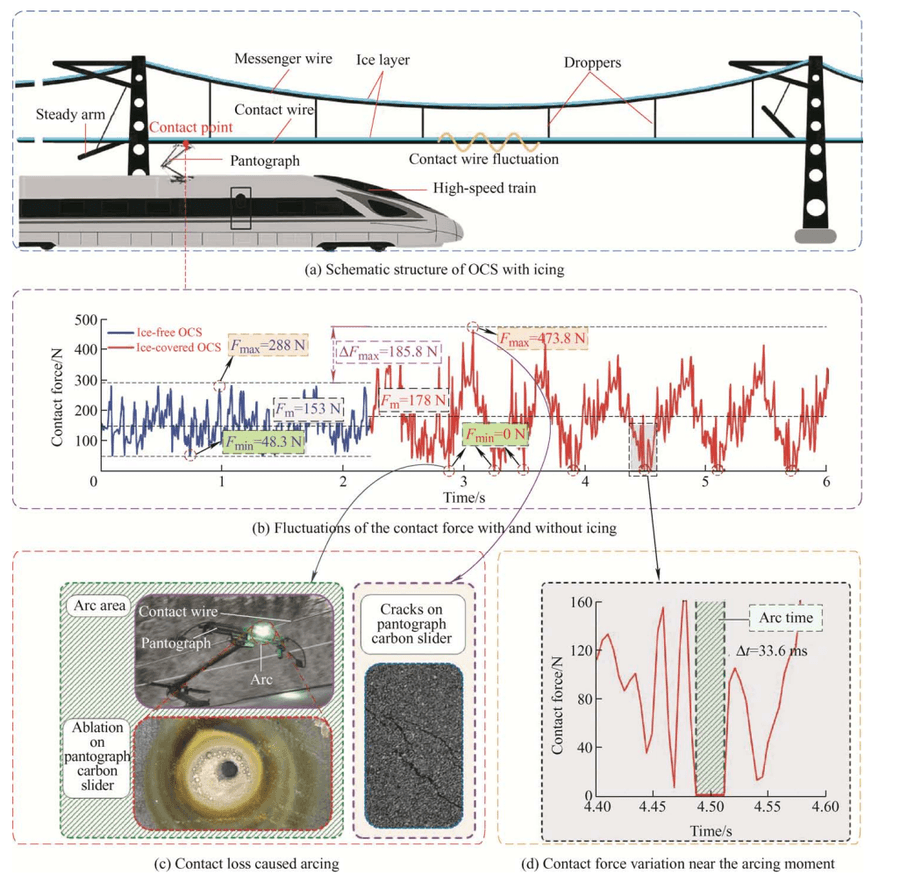
A pivotal study has been conducted to assess the adaptability of overhead contact systems (OCS) in high-speed railways under ice-covered conditions. This research is crucial for maintaining the continuous and safe collection of electrical energy in extreme environments. The study introduces a dynamic model to simulate and analyze the performance of the pantograph-catenary system (PCS) under different icing conditions, offering a new approach to evaluate and enhance system resilience.
The operation of high-speed railways often encounters disruptions due to icy conditions, which can cause significant mismatches in the interaction between the pantograph and catenary systems. Ice-covered overhead conductors lead to more intense fluctuations in contact force and increased incidence of arcing, undermining both safety and service reliability. Addressing these challenges requires an in-depth analysis of how overhead contact systems perform and adapt under icy environments.
Experts from Southwest Jiaotong University and the National Rail Transit Electrification and Automation Engineering Technology Research Center collaborated on this study, publishing their insights in the Chinese Journal of Electrical Engineering on June 30, 2024. The study pioneers a novel methodology for evaluating the adaptability of overhead contact systems amidst diverse ice-covered conditions.
This pioneering research provides a holistic evaluative framework for the OCS's challenges in icy conditions, which is essential for the continuous operation of high-speed rail. Through dynamic simulation of the PCS, the researchers calculated the complex response of the system under various ice loads. The model captures critical metrics such as contact force and arcing propensity, revealing system equilibrium and dependability. A key highlight of the research is the introduction of the sensitivity coefficient, a quantifiable indicator of the OCS's environmental responsiveness. Together with an analysis of five OCS prototypes, it offers a robust framework for evaluating their adaptability, guiding the design of more resilient railway systems.
Dr. Guangning Wu, an IEEE Fellow and esteemed academic, praised the research for its transformative potential in high-speed rail maintenance. "The advent of the OCS sensitivity coefficient is a quantum leap, providing us with precise standards for assessing the environmental impact of railway systems," he noted. "This work is set to redefine the fortitude of overhead contact systems in extreme climates."
The research is poised to reshape the blueprint and maintenance of railway infrastructure, particularly in icy conditions. By identifying the OCS structures most adept at withstanding frost and understanding their environmental sensitivity, rail operators can implement precise enhancements. This preemptive strategy not only fortifies the operational integrity and speed of high-speed rail but also contributes to economic infrastructure management, reducing the risk of service disruptions and their financial repercussions.