

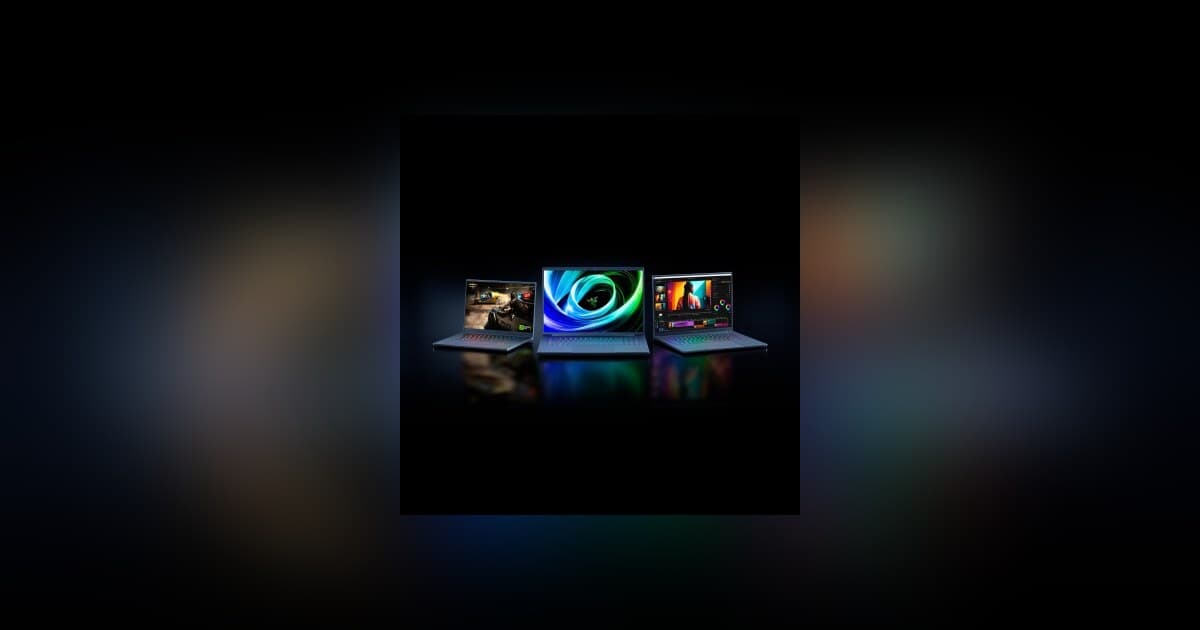
Razer has unveiled its 2026 Blade laptop lineup, comprising the Blade 14, Blade 16, and Blade 18, each engineered for specific user needs. The new models feature anodised aluminum unibody construction, vapor chamber cooling, and configurations with current-generation NVIDIA GeForce RTX 50 Series GPUs and the latest processors. According to Razer, the lineup is designed to dominate AAA gaming at 4K, AI workloads, and content creation.
The Razer Blade 14 targets gamers prioritizing portability. Weighing 1.63 kg and measuring 0.62 inches thin, it packs up to an RTX 5070 GPU (115W TGP) and an AMD Ryzen AI 9 365 processor with a 50 TOPS NPU. Its 72 Wh battery offers all-day use, and the 14-inch QHD+ OLED display runs at 120 Hz. Priced from $2,299 to $2,899, it suits students and frequent travelers.
The Razer Blade 16 balances performance and portability. It features up to an RTX 5090 laptop GPU (165W TGP) and an AMD Ryzen AI 9 HX 370 processor. The 16-inch QHD+ OLED display offers 240 Hz refresh rate with VESA TrueBlack 1000 HDR. With up to 64 GB of LPDDR5X-9600 MHz memory, it handles streaming, 4K video editing, and AI tasks. Weighing 2.14 kg and 14.9 mm thick, it fits a standard sleeve. Prices range from $2,399 to $5,599.
The Razer Blade 18 aims to replace desktops for power users. It offers up to an RTX 5090 GPU at 175W TGP and a 24-core Intel Core Ultra 9 290HX Plus processor. The 18-inch display options include UHD+ at 240 Hz or FHD+ at 440 Hz. It is the only model with slotted DDR5 RAM (up to 128 GB) and two M.2 NVMe slots (up to 8 TB). Triple-fan vapor chamber cooling sustains performance under heavy loads. Priced from $3,499 to $6,999, it targets hardcore gamers, AI developers, and professional creators.
The implications of this lineup are significant for users seeking specialized performance. The Blade 14 addresses the demand for a lightweight gaming laptop without sacrificing GPU power, ideal for mobile gamers. The Blade 16 offers a middle ground, enabling users to skip a desktop while still achieving high frame rates and color accuracy. The Blade 18 provides desktop-class performance with upgradeable components, potentially reducing the need for separate workstation and gaming setups. For AI developers, the Blade 18's high memory capacity and storage expandability support large model training, while the Blade 14's NPU handles on-device AI tasks. The variety ensures that whatever the user's priority—portability, balanced performance, or raw power—there is a configuration tailored to their workflow.
