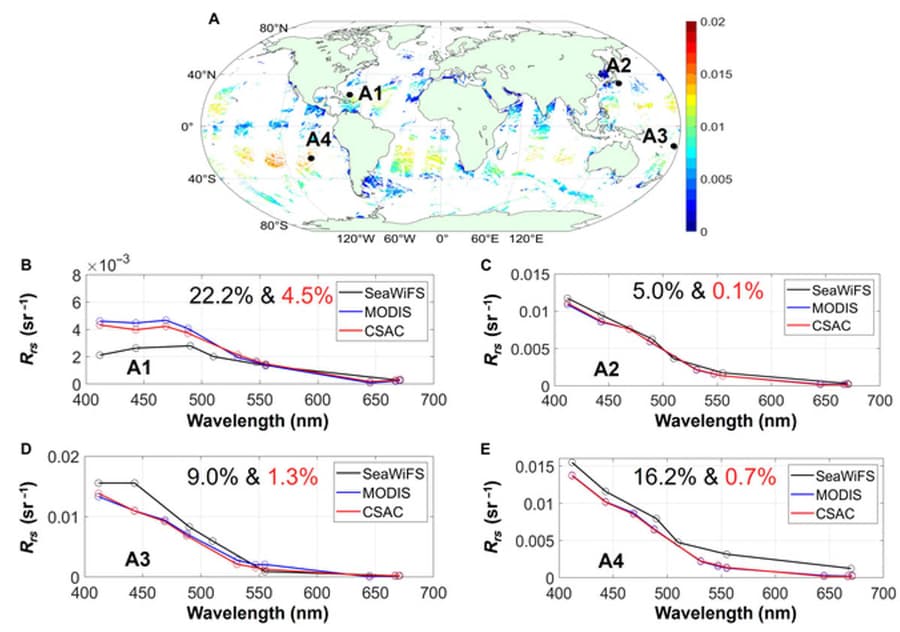
A groundbreaking advancement in satellite ocean color data processing has been unveiled, promising to revolutionize our understanding of marine ecosystems and their response to climate change. The Cross-Satellite Atmospheric Correction (CSAC) system, developed by researchers at the State Key Laboratory of Marine Environmental Science at Xiamen University in collaboration with the National Satellite Ocean Application Service, addresses long-standing challenges in merging data from different satellite missions.
The CSAC method, detailed in a study published in the Journal of Remote Sensing on November 7, 2024, uses artificial intelligence to align top-of-atmosphere reflectance data from various satellites with high-quality remote sensing reflectance (Rrs) data compiled by MODIS-Aqua. This innovative approach effectively resolves persistent data inconsistencies that have hindered comprehensive ocean monitoring efforts for decades.
Since the late 1990s, ocean color satellites have been instrumental in monitoring the upper ocean, providing crucial insights into the spatial distribution and temporal changes of important properties such as water clarity and phytoplankton concentration. However, discrepancies among different satellite missions due to variations in sensor design and atmospheric correction algorithms have complicated efforts to create unified, long-term datasets.
The CSAC system marks a significant departure from conventional atmospheric correction approaches. Instead of relying on sensor-specific algorithms, it employs machine learning techniques to process data from multiple satellites against a standardized Rrs database. This database, derived from over 20 years of MODIS-Aqua observations, serves as a reliable reference point, enabling CSAC to standardize data from other sensors like SeaWiFS and MERIS.
The effectiveness of CSAC is evident in its performance, with tests showing a reduction in discrepancies across wavelengths by up to 50% compared to traditional methods. This improvement in data consistency and accuracy is crucial for creating reliable, long-term records of ocean bio-optical properties, which are essential for tracking marine ecosystem changes and assessing global climate trends.
Dr. Zhongping Lee, one of the study's lead researchers, emphasized the significance of CSAC, stating, "By harnessing decades of the highest-quality MODIS-Aqua data and sophisticated machine-learning techniques, we have resolved critical inconsistencies in Rrs among different satellites. This not only improves data reliability but also empowers the scientific community to create accurate, long-term records of ocean bio-optical properties, essential for climate studies."
The implications of this advancement are far-reaching. With CSAC, scientists can now produce reliable, long-term data products from multiple satellite missions, enabling more comprehensive observations of shifts in ocean ecosystems, examination of the ocean's role in the carbon cycle, and evaluation of climate change impacts. This consistent and accurate ocean color record is invaluable for researchers studying global climate trends and marine ecosystem dynamics.
Furthermore, CSAC's AI-based approach sets a new standard for future satellite data processing. It signifies a shift from traditional radiative-transfer-based approaches to more sophisticated data-based systems, potentially ushering in a new era of satellite data analysis and interpretation.
As climate change continues to impact our oceans, the ability to accurately monitor and understand these changes becomes increasingly critical. The CSAC system provides researchers with a powerful tool to create comprehensive, long-term datasets that can inform policy decisions, guide conservation efforts, and deepen our understanding of the complex interactions between our oceans and the global climate system.
The development of CSAC represents a significant step forward in our ability to monitor and understand the world's oceans. By providing more accurate and consistent data across different satellite missions, it enhances our capacity to track changes in marine ecosystems over time, ultimately contributing to more informed and effective strategies for ocean conservation and climate change mitigation.