A team of international researchers has made a significant breakthrough in thermal photonics, developing a method to achieve efficient subambient daytime radiative cooling for vertical surfaces. This innovation, detailed in a recent study published in Science, could have far-reaching implications for energy conservation and thermal management across various industries.
Led by Professor Wei Li from the Changchun Institute of Optics, Fine Mechanics and Physics (CIOMP) of the Chinese Academy of Sciences, in collaboration with teams from Stanford University and the City University of New York, the researchers have designed an angularly asymmetric and spectrally selective thermal emitter (AS emitter) that overcomes the limitations of traditional radiative coolers.
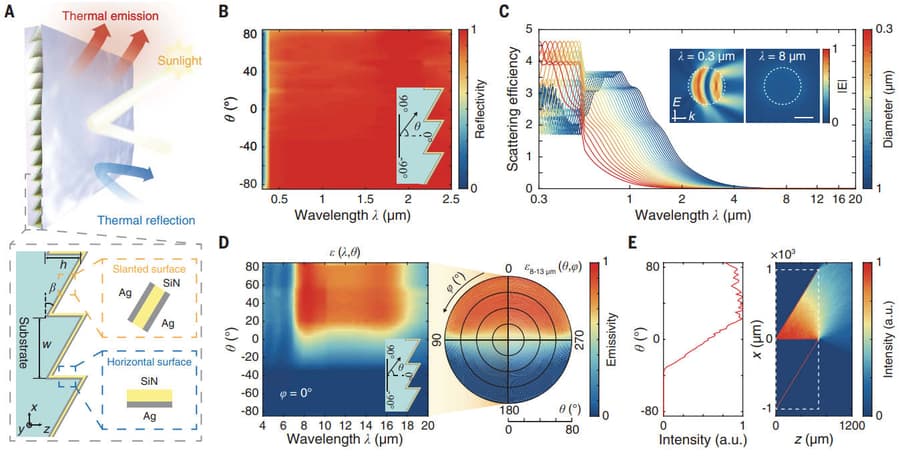
Conventional radiative coolers, which typically exhibit omnidirectional thermal radiation properties, are only effective on horizontal surfaces. When applied to vertical surfaces, their effectiveness is significantly reduced due to the limited view of the cold sky and heat absorption from surrounding objects and the atmosphere. The newly developed AS emitter addresses this challenge by utilizing thermal photonics to achieve cross-band synergistic control of thermal radiation in both angle and spectrum.
The AS emitter's design incorporates a cross-scale symmetry-breaking structure, consisting of a sawtooth grating covered by an ultraviolet-visible reflective, IR transparent nanoporous polyethylene film. This innovative structure allows for precise control over the direction and spectrum of thermal emission, enabling the emitter to maintain temperatures below ambient levels even under peak sunlight conditions.
In tests, the AS emitter demonstrated remarkable performance, maintaining a temperature 2.5°C below ambient temperature during peak sunlight hours. This represents a temperature reduction of 4.3°C and 8.9°C compared to conventional high-performance radiative coolers and commercial white paint, respectively. The flexibility of the design allows for customization based on specific practical scenarios, including situations where the emitter faces hot surfaces like building walls.
The implications of this breakthrough are substantial. The ability to achieve subambient cooling on vertical surfaces opens up new possibilities for energy-efficient technologies in buildings, vehicles, and even clothing. By reducing the need for active cooling systems, this technology could significantly decrease energy consumption and contribute to global efforts to combat climate change.
Furthermore, the versatility of the AS emitter's design strategy suggests potential applications in a wide range of real-world scenarios involving inclined or vertical surfaces. This dimensional leap in radiative cooling technology, from horizontal surfaces to practical three-dimensional scenarios, represents a major advancement in the field of thermal management.
As the global community continues to seek innovative solutions for energy efficiency and sustainability, this breakthrough in thermal photonics offers a promising pathway forward. The ability to passively cool vertical surfaces without energy input could revolutionize architectural design, vehicle manufacturing, and personal comfort technologies.
While further research and development will be necessary to bring this technology to commercial applications, the potential impact on energy consumption and thermal management is significant. As cities and industries worldwide grapple with the challenges of climate change and energy efficiency, innovations like the AS emitter provide hope for a cooler, more sustainable future.
The study, supported by funding from the National Natural Science Foundation of China, the US Department of Energy, and a Vannevar Bush Faculty Fellowship, underscores the importance of international collaboration in addressing global challenges. As researchers continue to push the boundaries of thermal photonics, we may soon see a new generation of energy-efficient technologies that leverage the power of directional thermal emission to create cooler, more comfortable environments while reducing our carbon footprint.