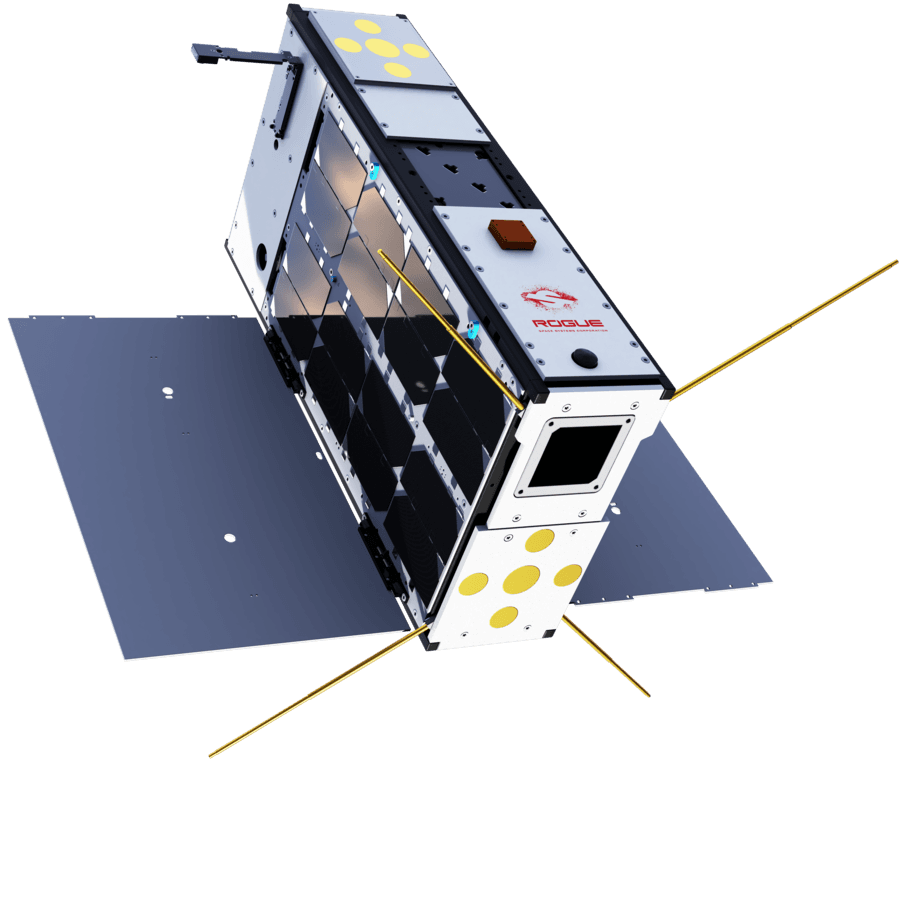
Rogue Space Systems Corporation has revealed the full manifest for its upcoming OTP-2 spacecraft mission, scheduled to launch no earlier than February 2025. This mission represents a significant step forward in the company's pursuit of advanced In-Space Logistics services, with a focus on close-proximity maneuvering and docking capabilities.
The OTP-2 spacecraft will carry an array of innovative technologies, including an undisclosed payload, a new propulsion system, an encryption system, and a new edge computing device. Additionally, the spacecraft will be equipped with five optical sensors and a star tracker, enhancing its observational and navigational capabilities.
A key feature of the OTP-2 mission is the next-generation Scalable Compute Platform (SCP), which will serve as a testbed for critical computer vision, autonomy, and AI computations through Edge Computing. This platform will be instrumental in testing Rogue's new ASTRA autonomy system, designed to maintain spacecraft health and execute operational goals autonomously.
The mission will also showcase three hosted payloads from emerging space technology companies. Forward Edge AI will demonstrate their Isidore Quantum® Space Encryptor, a quantum-resistant encryption system in a compact form factor. IVO Limited will test their Quantum Drive, touted as the world's first propellant-free pure electric propulsion system.
Rogue Space Systems CEO Jon Beam emphasized the significance of this mission, stating, "This is a foundational next step for Rogue Space Systems, propelling us forward towards our vision of providing in-space logistics services, and for establishing our credibility as a reliable in-space service provider."
The OTP-2 mission is expected to have far-reaching implications for the space industry. By demonstrating advanced autonomous capabilities and hosting innovative payloads, Rogue is positioning itself at the forefront of in-space logistics and services. The successful implementation of these technologies could pave the way for more efficient and cost-effective space operations, potentially revolutionizing how satellites and other spacecraft are maintained and serviced in orbit.
The advancements in propulsion and encryption systems being tested on OTP-2 could also have significant impacts on satellite longevity, security, and maneuverability. The propellant-free Quantum Drive, if successful, could dramatically reduce the weight of future spacecraft and extend their operational lifespans. Meanwhile, quantum-resistant encryption could become crucial as the threat of quantum computing to current encryption methods looms on the horizon.
Furthermore, Rogue's approach of offering commercial payload hosting opportunities on its missions presents a new model for space technology development. This strategy allows smaller companies and innovators to test their technologies in space without the enormous costs typically associated with launching dedicated missions.
Looking ahead, Rogue is already planning its next mission, OTP-3, slated for launch in 2026. This larger spacecraft is expected to further expand on the capabilities demonstrated in OTP-2, featuring rendezvous and proximity operations (RPO) capabilities, increased maneuverability, and a docking port for refueling.
As the space industry continues to evolve rapidly, missions like OTP-2 play a crucial role in advancing the technologies needed for the sustainable development of space infrastructure. The success of this mission could accelerate the growth of commercial space services and bring us closer to realizing the vision of a dynamic, industrialized space economy.