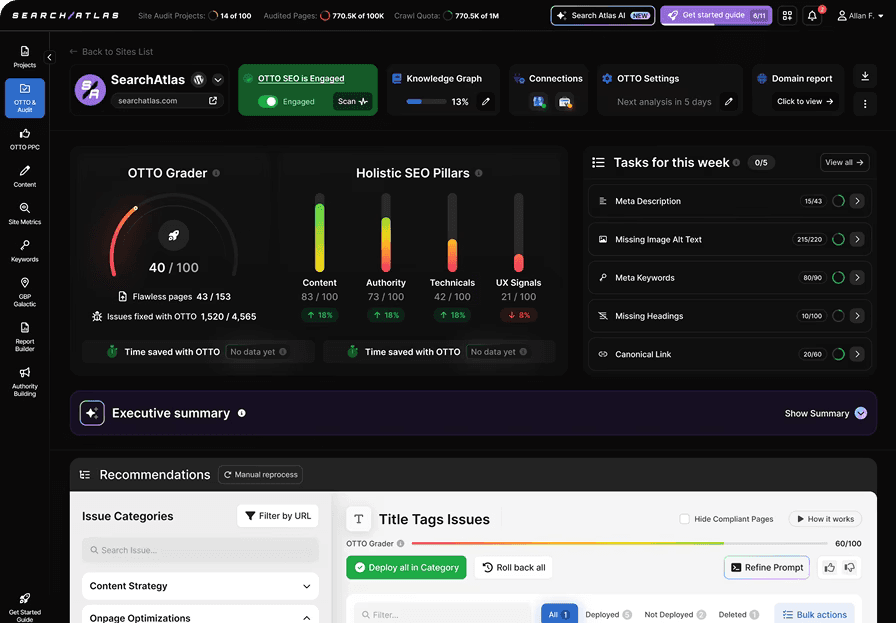
A new study analyzing automated technical SEO fixes across 39,486 websites provides empirical evidence that these optimizations significantly improve organic search performance, with sites experiencing an average 146% long-term impression increase. The research, conducted by Search Atlas, reveals that automated technical SEO delivers consistent, measurable improvements across impressions, keyword coverage, rankings, and user engagement metrics, challenging previous industry debates about the effectiveness of such fixes.
The comprehensive study analyzed five core SEO performance metrics, revealing substantial improvements following automated technical SEO implementations. Sites gained an average of 67 additional ranking keywords, demonstrated a 0.03 percentage point click-through rate improvement long-term, and achieved a 2-position average ranking improvement. The research found that 64.5% of analyzed websites improved keyword coverage, with only 26.1% declining, indicating predictable outcomes across diverse website profiles.
Specific technical SEO fixes produced the strongest performance improvements, with schema markup implementation delivering a 150.5% improvement in impressions and missing heading resolution generating 114.3% gains. Additional high-impact optimizations included canonical tag consolidation with 63.9% CTR improvement, meta keyword and title tag refinement with 61.5% CTR gains, and image alt text optimization with 64.3% keyword expansion. These findings demonstrate that technical elements search engines use to understand and rank content are performance drivers with quantifiable ROI when properly automated.
Website size determined optimal technical SEO strategy, with small sites benefiting most from foundational fixes including schema markup and heading optimization, medium sites gaining maximum value from heading hierarchy implementation and canonical link optimization, and large enterprise sites experiencing the most substantial absolute gains through canonical consolidation and systematic heading hierarchy. Large sites gained over 2,370 impressions on average, demonstrating how automation compounds improvements across thousands of URLs.
Click-through rate emerged as the strongest long-term predictor for organic search success, particularly for medium and large websites. CTR improvements were driven primarily by resolving missing headings, optimizing title tags, implementing canonical consolidation, and deploying schema markup. These improvements translate directly into more clicks, with modest percentage gains representing thousands of additional visitors and substantial revenue impact across millions of impressions.
The research methodology combined data from Search Atlas's Content Assistant, OTTO PPC, and Google Search Console, employing linear regression analysis, interaction terms to measure before-and-after changes, and k-means clustering on log-transformed metrics to segment websites by size. Statistical significance was confirmed through p-values and R² testing, with outlier exclusion ensuring data integrity across the nearly 40,000 websites analyzed.
As search engines increasingly rely on AI and machine learning algorithms to understand and rank content, technical SEO infrastructure becomes more critical for competitive organic visibility. Websites that maintain clean technical foundations with proper schema, logical heading hierarchies, and consolidated canonicals are those that AI systems can most effectively parse, understand, and recommend. This positions automated technical SEO as essential for organizations seeking visibility in evolving search environments where Generative Engine Optimization and AI-driven results are reshaping content discovery.