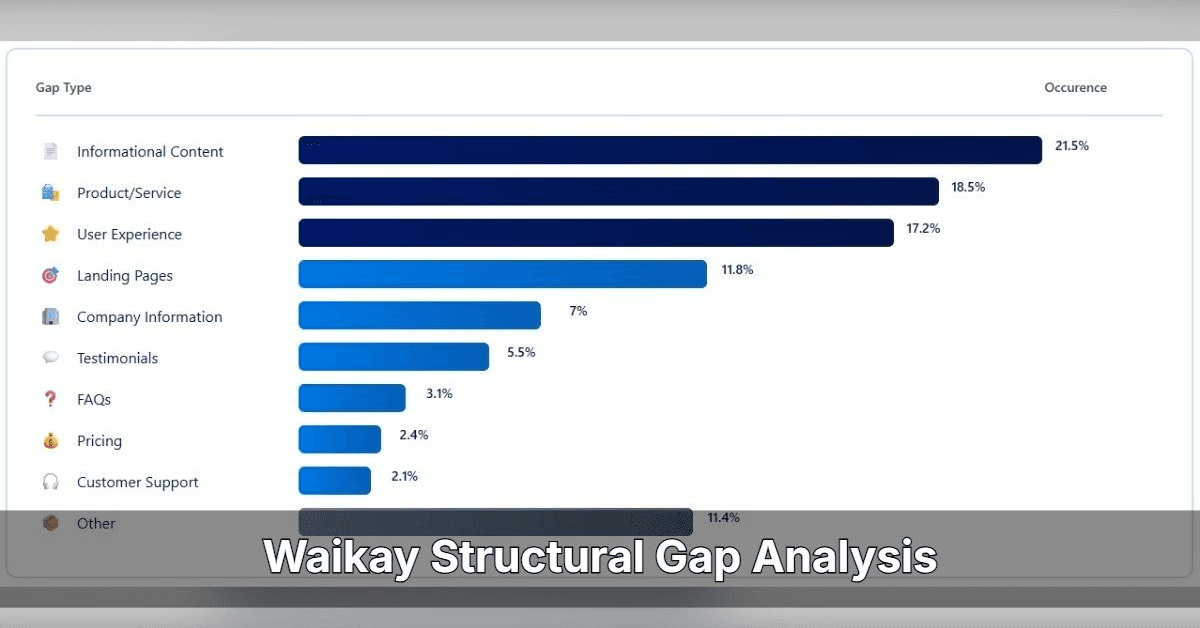
InLinks, the company behind the AI Brand Visibility platform Waikay.io, has released findings from a structural analysis of 5,000 websites that identified 19,000 distinct gaps measurably reducing brand visibility across both traditional search engines and AI-powered platforms including ChatGPT, Perplexity, and Google SGE. The research represents one of the first efforts to quantify the relationship between site architecture and AI search performance, revealing that more than half of all identified gaps (57%) fall into three categories: missing informational content (21.5%), absent product or service pages (18.5%), and UX or structural deficiencies (17.2%).
While traditional SEO guidance has long addressed missing pages and poor site structure, AI-powered search introduces new urgency according to the findings. Platforms like ChatGPT and Perplexity synthesize responses from multiple sources, drawing on entity associations and content coverage rather than simple keyword matching. Websites with structural gaps, missing topic clusters, orphaned pages, or thin category coverage are more likely to be bypassed entirely by these AI systems. "Businesses that have ignored structural issues may not have felt the consequences in traditional search yet, but in AI search, those gaps are immediate and significant," said Dixon Jones, CEO of InLinks.
The research indicates that 57% of all identified gaps cluster into three root causes, suggesting most websites share common structural weaknesses rather than unique problems. Missing informational content represents the single largest category, with the absence of educational and explanatory pages that AI engines use to determine topical authority. UX and structural deficiencies affect crawlability and internal linking, limiting a site's ability to signal relationships between content, which is critical for AI entity recognition. The severity and priority of gaps varies significantly by industry, competitive context, and customer journey stage, indicating that a one-size-fits-all remediation approach is unlikely to be effective.
The report includes third-party case evidence alongside InLinks' own testing. A major accounting software provider increased its AI entity associations for the term 'e-invoicing' by 650% following a program of strategic internal linking, a change that required no new external links or paid media. InLinks separately validated the hub-and-cluster content methodology by improving its own AI recommendation ranking from 6th to 1st for a target category. The analysis was conducted using the Waikay.io platform, which audits websites against a structured taxonomy of gap types. The 5,000 sites were drawn from InLinks' client and research database across multiple industries and geographies, with each gap assessed against both traditional search signals and AI engine behavior patterns observed between 2024 and 2025. The full methodology is published in the report available at https://waikay.io/action-plans/seo-structural-gap-analysis/.