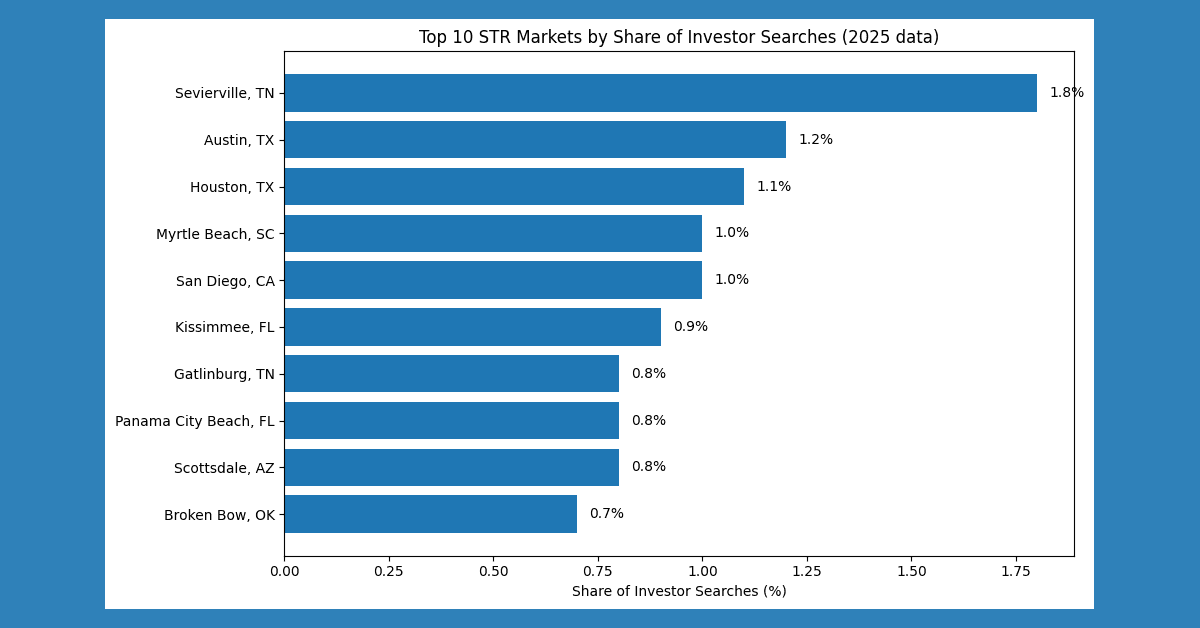
Data from short-term rental platform Chalet shows that nearly one-third of all Airbnb market searches in 2025 focused on just three Sun Belt states, highlighting the continued dominance of these markets while revealing significant shifts in investor behavior toward regional destinations. The analysis, based on tens of thousands of searches across 3,080 U.S. cities, indicates that Florida, California, and Texas together accounted for 32.5% of all searches on Chalet's investment tools, with this search activity translating directly into execution as these states represented 69% of the platform's closed deals.
The data reveals a clear preference for secondary "drive-to" vacation markets over traditional urban hotspots, with nearly 70% of the 30 most-searched short-term rental markets being regional or destination-driven rather than large urban metros. Sevierville, Tennessee, a gateway to the Smoky Mountains, ranked as the most-searched individual city with 1.8% of total searches, outperforming major cities like Austin, Texas (1.2%) and San Diego, California (1.0%). This trend carried through to actual purchases, with 73% of Chalet-assisted deals occurring in regional markets, suggesting investors are seeking opportunities where traveler demand remains strong but competition may be lighter.
Despite the concentration of searches in Sun Belt states, market interest remained widely distributed, with no single city dominating search volume. The most-searched individual market accounted for only about 1.8% of total searches, indicating fragmented interest across dozens of markets. This distribution contrasts with execution patterns, where purchases became more concentrated, with Austin, Texas emerging as the single most active market for closed deals at just over 9% of all transactions. Additional information about market trends is available through Chalet's free interactive market dashboard.
Chalet reported closing 205% more short-term rental property deals in 2025 compared to the previous year, indicating that users are converting analysis into executed transactions at an accelerated pace. The platform's growth reflects broader momentum in short-term rental investments, though the gap between widely distributed market searches and more concentrated purchases underscores the importance of detailed ROI modeling and market-level insights to help investors narrow opportunities into execution-ready decisions.
Regulatory environments emerged as a critical factor shaping market interest, with strict short-term rental regulations significantly suppressing investor attention. Interest in regulation-heavy metros like New York City and Los Angeles was negligible, accounting for under 0.2% of all city-level searches despite their status as major tourism destinations. This pattern highlights how restrictive frameworks limit short-term rental viability, causing investment activity to concentrate in markets with more stable and host-friendly policies.
The data suggests that while Sun Belt states continue to attract substantial investor attention, the search for opportunities is expanding beyond traditional hotspots to regional gems where regulatory environments are more favorable. This shift has important implications for real estate investors, tourism economies, and local housing markets, as capital flows toward secondary vacation destinations rather than major urban centers. The trend toward regional markets may indicate changing traveler preferences and investment strategies as the short-term rental industry matures and adapts to regulatory pressures.