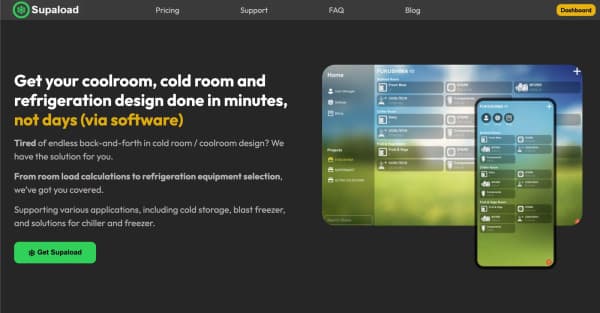
Engineering professionals in refrigeration and cold storage industries now have access to a sophisticated web-based design tool that promises to dramatically reduce project development time. Supaload, a new software platform, introduces comprehensive capabilities for designing complex refrigeration systems across multiple industries with unprecedented speed and accuracy.
The software addresses long-standing challenges in refrigeration system design by providing instant load calculations, automated equipment selection, and a user-friendly interface accessible on desktop and mobile devices. Professionals can now generate detailed refrigeration system designs in minutes, replacing traditional processes that previously consumed days of manual calculations and component selection.
Key innovations include automatic calculation of cooling requirements, smart selection of critical components like evaporators, compressors, condensers, and expansion valves, and the ability to design systems ranging from single-unit setups to complex multi-compressor installations. The platform's automatic Bill of Materials generation further streamlines project management by enabling efficient component tracking and selection.
Supaload offers flexible subscription models targeting different professional needs, including individual contributor, collaborative, and enterprise-level plans. This tiered approach allows professionals from various sectors—including food storage, pharmaceuticals, and industrial refrigeration—to access tailored design solutions matching their specific project requirements.
The software's potential impact extends beyond time savings. By standardizing design processes and providing precise calculation tools, Supaload could contribute to more energy-efficient refrigeration systems, potentially reducing operational costs and environmental footprint across multiple industries.
With its launch, Supaload represents a significant technological advancement in engineering design software, offering a comprehensive solution that transforms how refrigeration systems are conceptualized, calculated, and implemented.