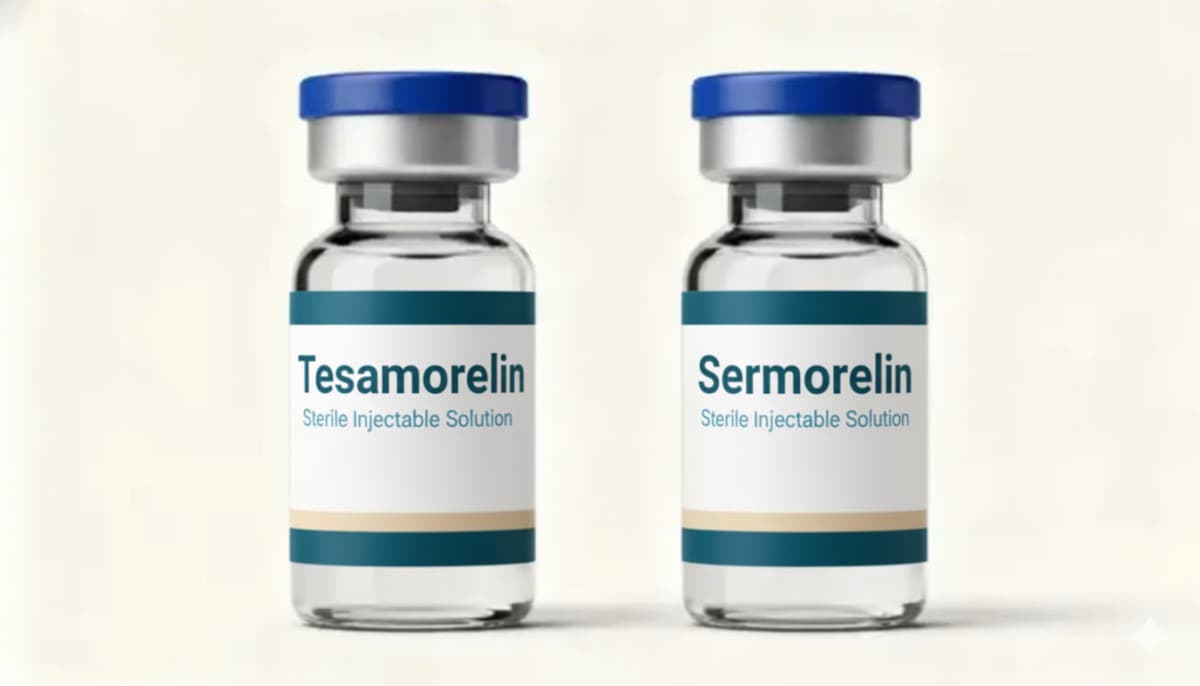
Tesamorelin and Sermorelin represent two distinct synthetic variants of growth hormone-releasing hormone (GHRH) with significant implications for research design and experimental outcomes. Both peptides interact with pituitary receptors to promote growth hormone (GH) release, but their structural differences create divergent pharmacological profiles that researchers must consider when designing studies involving metabolic signaling, tissue recovery, and endocrine regulation.
Tesamorelin consists of 44 amino acids and functions as a stabilized analog engineered to enhance receptor affinity and extend its half-life. This structural design facilitates sustained receptor engagement, resulting in prolonged downstream activity of GH and insulin-like growth factor 1 (IGF-1). In experimental settings, this profile associates with targeted lipolytic effects in visceral adipose tissue and observable alterations in metabolic signaling markers, making it particularly suitable for research requiring sustained GH and IGF-1 elevations.
Conversely, Sermorelin comprises a 29-amino-acid fragment corresponding to endogenous GHRH(1-29). This peptide promotes GH release from the pituitary in a pulsatile manner that closely mimics natural secretion patterns. The resulting physiological rhythm produces intermittent spikes in GH and IGF-1 levels, which may affect recovery processes, metabolic signaling, and anabolic pathways in research models where rhythmic stimulation proves pertinent. This characteristic makes Sermorelin ideal for experiments necessitating physiological pulsatile GH release or where cyclic receptor stimulation serves as a key focus.
The pharmacological distinctions between these peptides create clear experimental applications. Tesamorelin's sustained stimulation supports research focused on visceral adipose modulation and prolonged anabolic signaling, while Sermorelin's pulsatile pattern advantages studies investigating physiological GH dynamics, endocrine rhythms, and tissue recovery mechanisms. Researchers must align molecular length and receptor profile with experimental objectives, as the choice between these peptides hinges on whether continuous lipolytic/metabolic signals or pulsatile endocrine regulation better serves the research goals.
Both peptides require careful handling and storage considerations to maintain stability. Lyophilized peptides should store at low temperatures (-20°C to -80°C) protected from moisture and light, while reconstituted peptides require immediate preparation in sterile conditions with appropriate solvents such as sterile water, bacteriostatic water, or minimal DMSO for hydrophobic sequences. Researchers should aliquot samples to minimize freeze-thaw cycles and clearly label vials with peptide name, concentration, solvent, and preparation date to ensure reproducibility. Additional information about proper handling protocols can be found at https://lotilabs.com.
Future research directions may include combination studies involving GH secretagogues or metabolic modulators to reveal additive or synergistic signaling effects. Long-term stability research and comparisons of pulsatile versus sustained stimulation models can enhance experimental design, while comparative assessment of Tesamorelin and Sermorelin's effects on downstream molecular pathways can inform selection for mechanistic studies. The distinct characteristics of these peptides provide researchers with specialized tools for investigating different aspects of growth hormone physiology and metabolic regulation.