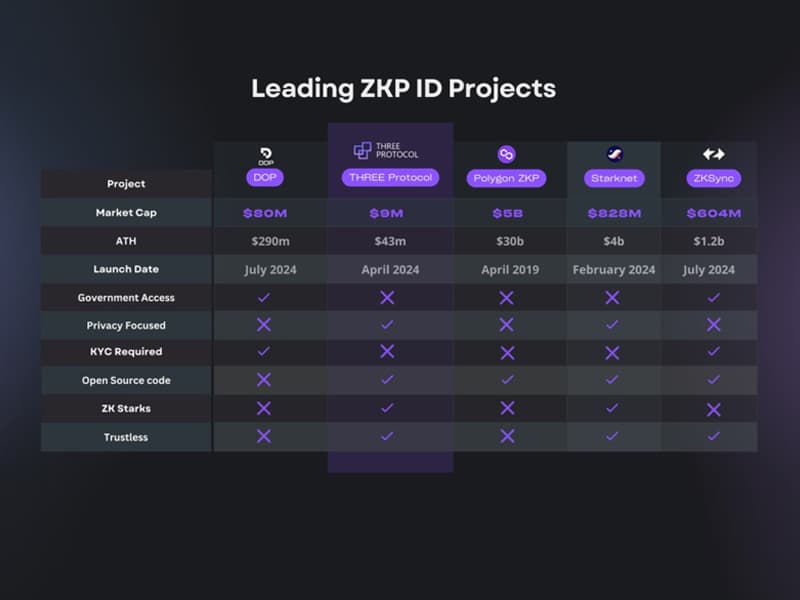
Three Protocol, a pioneering project, has announced the development of a decentralized digital ID system and zero-knowledge proof (ZKP) technology that bypasses traditional KYC (Know-Your-Customer) requirements. This innovative solution aims to provide users with a secure and private digital interaction experience within a fully decentralized environment, rivaling industry leaders like Polygon ZKP, Starknet, zkSync, and DOP.
With the rise of the Web3 economy, the demand for blockchain-based systems that ensure performance, security, and privacy has surged. Traditional Web 2.0 frameworks often rely on national identification and KYC processes, which can compromise user privacy and exclude unbanked individuals from participating in online economic activities. Three Protocol's approach addresses these issues by allowing users to create decentralized digital IDs (ZKi3s) without the need for national ID or biometric data.
The primary advantage of Three Protocol's system is its elimination of KYC requirements, enabling unbanked and debanked communities to engage in online commerce using only a crypto wallet. The zero-knowledge proof pseudonymized digital IDs ensure that a user's profile is an immutable blockchain entry, keeping transactions private and secure.
ZKi3s function as no-KYC, zero-knowledge proof blockchain entries that represent the owner's online reputation and relationship history. These IDs can be used to send ZK-Stark proofs between review issuing protocols and other systems, allowing users to collect reviews or reputation scores for digital interactions without exposing their identity publicly on the blockchain.
Three Protocol has confirmed that the algorithmic formulae for ZKi3s will be open source, enabling seamless integration with any digital platform or online marketplace via a permissionless process. Additionally, the project uses a Neural Network AI model with advanced alphanumeric AI algorithms to provide a real-time updated interface for products, services, and real-world assets, further enhancing user experience.
In terms of privacy, Three Protocol leverages ZK-Stark technologies to ensure user anonymity, setting it apart from other projects. For instance, Polygon ZKP emphasizes scalability over privacy, while zkSync requires KYC verification despite using ZK-Rollups to protect user information. DOP, on the other hand, adopts a selective transparency policy that may compromise user confidentiality.
Three Protocol's commitment to open source code allows the community to contribute and scrutinize its development, enhancing trustworthiness. The use of ZK-STARKs provides robust security against privacy threats and boosts performance without sacrificing decentralization, a practice followed by only a few other projects like Starknet.
The project also employs tri-signature smart contracts and DAO governance to ensure a fully decentralized and trustless experience, including unbiased dispute resolution and self-custody. This approach sets an industry standard, only matched by a few other brands such as Starknet and zkSync.
Overall, Three Protocol's innovative approach to decentralized digital IDs and no-KYC solutions marks a significant advancement in online marketplace interactions. By prioritizing privacy, inclusivity, and decentralization, the project promises to reshape the landscape of digital identity and commerce, offering a more secure and accessible platform for users worldwide.