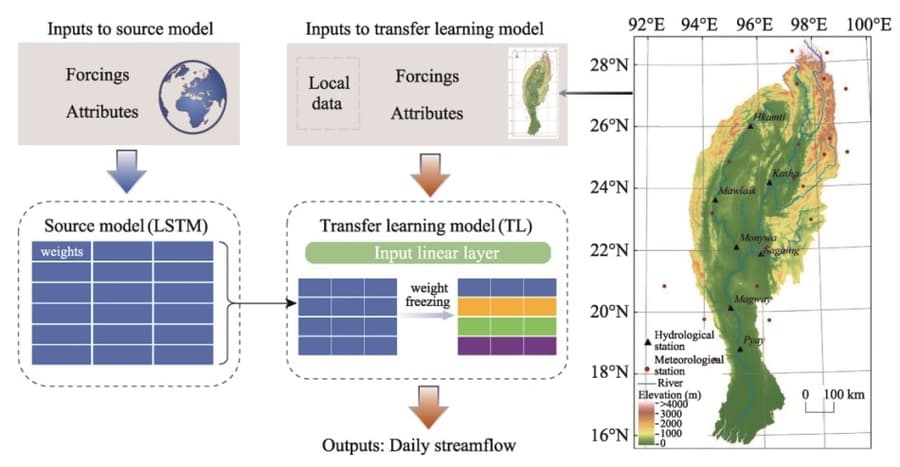
Researchers have made a significant advancement in the field of streamflow prediction by utilizing transfer learning to develop a model that substantially increases the accuracy of daily streamflow forecasts. This innovation is crucial for improving water resource management and formulating effective climate change mitigation strategies.
Streamflow modeling is essential for securing water supplies and assessing climate change impacts, but it often falls short due to the uneven global distribution of gauges and the lack of data in extensive transboundary basins. These challenges have long necessitated a novel modeling approach capable of navigating these constraints. The new transfer learning model addresses these issues by learning from related tasks to enhance its performance in data-scarce regions.
In a landmark publication in the Journal of Geographical Sciences, a joint research team from Yunnan University and Pennsylvania State University introduced this transfer learning framework. The model excels at predicting daily streamflow in regions like the Dulong-Irrawaddy River Basin, which has traditionally been under-researched due to data limitations. The study’s innovative approach is expected to significantly enhance water resource management in areas with limited hydrological data.
Rigorously tested in the Dulong-Irrawaddy River Basin, the new model outperforms conventional process-based models and demonstrates remarkable adaptability to the basin's unique hydrological features. Sensitivity analysis of the model reveals its proficiency in capturing complex, nonlinear interactions among variables. Integrated gradients analysis highlights its ability to delineate diverse flow patterns and spatial variations, suggesting that the model can deepen our understanding of hydrological processes within large-scale catchments.
Dr. Ma Kai, a principal investigator and co-author of the study, emphasized the research's significance, stating, "This research not only meets the urgent demand for reliable streamflow predictions in regions with limited data but also paves the way for a more profound comprehension of the complex dynamics governing our hydrological systems."
The findings of this study have far-reaching implications, offering a transformative tool for water resource management in transboundary basins. The introduction of this transfer learning approach marks a paradigm shift in water resource forecasting and management. It provides robust solutions to the challenges posed by data scarcity and climate change, thereby strengthening water security in vulnerable regions.
References:
DOI: 10.1007/s11442-024-2235-x
Funding information: National Key Research and Development Program of China, No.2022YFF1302405; National Natural Science Foundation of China, No.42201040; The National Key Research and Development Program of China, No.2016YFA0601601; The China Postdoctoral Science Foundation, No.2023M733006.
About Journal of Geographical Sciences: Journal of Geographical Sciences is an international and multidisciplinary peer-reviewed journal focusing on human-nature relationships. It publishes papers on physical geography, natural resources, environmental sciences, geographic information, remote sensing, and cartography. Manuscripts come from different parts of the world.