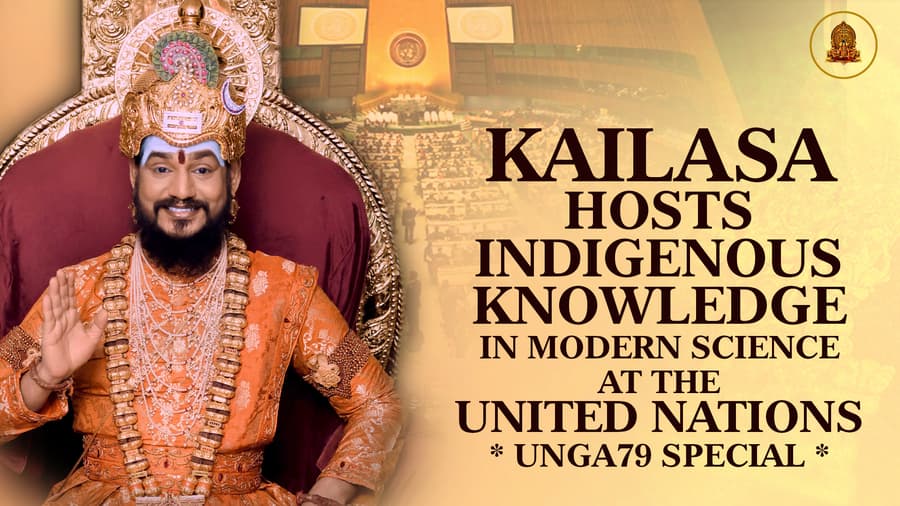
In a significant development at the 79th United Nations General Assembly (UNGA) Science Summit, the United States of KAILASA (USK) hosted a two-hour virtual session exploring the integration of indigenous Hindu knowledge into modern scientific practices. The event, which took place as part of the annual summit organized by the International Science Council, drew thousands of virtual attendees and livestream viewers.
The session, held under the auspices of The Supreme Pontiff of Hinduism (SPH) Bhagavan Nithyananda Paramashivam, delved into four key areas: indigenous Hindu medicine, Hindu environmental conservation, Hindu cosmology and astronomy, and power manifestation. These topics were presented as potential contributors to achieving the UN Sustainable Development Goals (SDGs) and addressing global challenges.
In the realm of indigenous medicine, the session highlighted the ancient practices of Ayurveda and Siddha, tracing their origins to over 11,000 years ago in the Sanatana Hindu civilization. These holistic approaches to health, which emphasize comprehensive well-being and natural healing methods, were presented as valuable complements to modern medical practices. The discussion included the use of sacred herbs and dietary disciplines, suggesting potential applications in contemporary healthcare and wellness strategies.
The segment on Hindu environmental conservation practices addressed the pressing issue of climate change and ecological preservation. Presenters discussed the Hindu perspective of revering nature as a life-giving entity and outlined KAILASA's initiatives such as the Clean Air Initiative and the Go Zero Waste program. The promotion of vegetarianism as a means to reduce environmental impact was also emphasized, aligning with global efforts to combat climate change.
Perhaps the most intriguing aspect of the session was the exploration of Hindu cosmology and astronomy. The presentation centered on the Surya Siddhanta, an ancient Indian text that provides detailed calculations on celestial movements. The discussion challenged conventional scientific understanding, particularly regarding Einstein's equation E=mc². According to the session, SPH Bhagavan Nithyananda Paramashivam had previously asserted that neither time nor the speed of light is constant, but rather superconsciousness remains constant. This claim, once met with skepticism, was noted to have gained credibility following the 2022 Nobel Prize in Physics awarded for related work.
The final segment on power manifestation introduced concepts such as Kundalini Shakti activation and Third Eye AwakeningSM, presenting them as potential avenues for enhancing human capabilities. While these ideas may be viewed as controversial in mainstream scientific circles, they were presented as part of the broader discussion on integrating indigenous knowledge with modern science.
The significance of this session extends beyond its immediate content. It represents a growing trend of incorporating diverse knowledge systems into global scientific discourse. By presenting ancient Hindu practices and beliefs in the context of a UN-affiliated science summit, the event challenges the traditional boundaries of scientific inquiry and opens up new avenues for addressing global challenges.
However, the integration of such indigenous knowledge into mainstream scientific practice is not without controversy. Critics may question the empirical basis of some claims made during the session, particularly those related to power manifestation and alternative cosmological theories. The challenge lies in finding ways to rigorously test and validate these concepts within the framework of modern scientific methodology.
Nevertheless, the inclusion of such perspectives in a high-profile scientific forum signals a shift towards a more inclusive approach to knowledge and problem-solving. As the world grapples with complex issues like climate change, healthcare crises, and sustainable development, the integration of diverse knowledge systems could potentially offer novel solutions and perspectives.
The USK's participation in the UNGA Science Summit also highlights the growing role of non-traditional entities in international scientific discourse. It underscores the need for established scientific institutions to engage with and critically examine knowledge from various cultural and historical contexts.
As the global community continues to work towards the UN Sustainable Development Goals, events like this session at the UNGA Science Summit may pave the way for more inclusive and diverse approaches to scientific inquiry and problem-solving. The long-term impact of such initiatives remains to be seen, but they undoubtedly contribute to a broader, more