

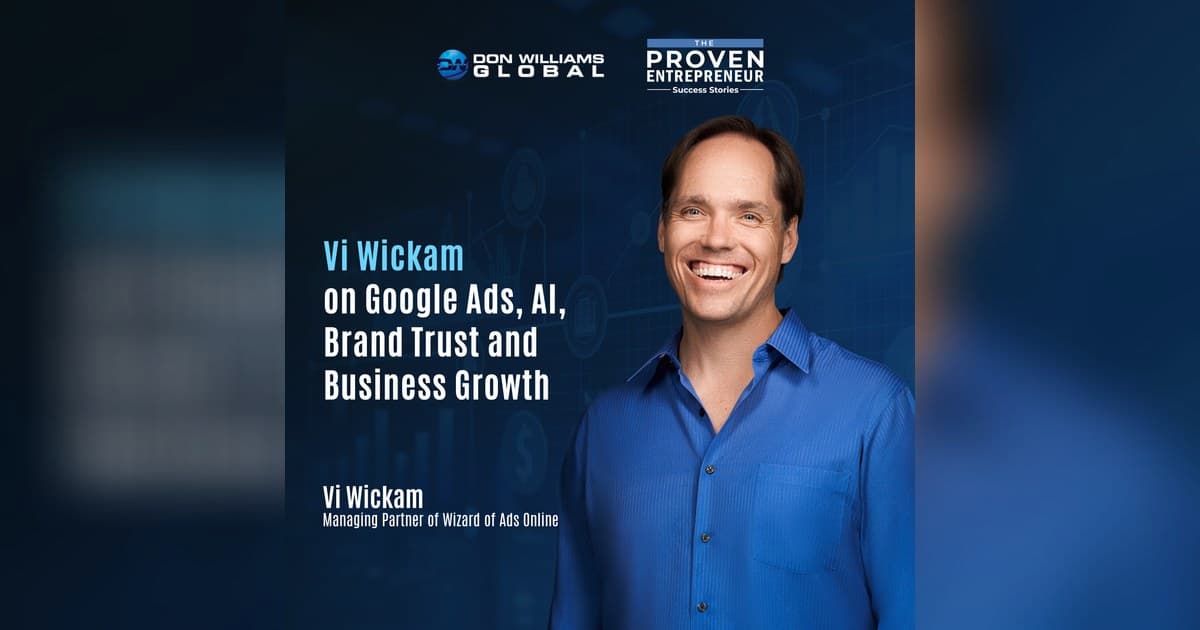
Vi Wickam, partner at Wizard of Ads Online and a manager of roughly half a million dollars monthly in Google Ads spend across North America, is sounding an alarm about industry practices that he says quietly drain business revenue. In Episode 164 of The Proven Entrepreneur, released June 12, 2026, Wickam and host Don Williams dissect the digital marketing myths that keep entrepreneurs from seeing real returns.
Wickam’s central warning: More ad spend rarely equals more revenue. He explains that agencies often blend brand and non-brand keyword performance in reporting, allowing them to claim credit for conversions the brand earned organically. “If a Google Ads manager says that you pay me and I pay Google, run away,” Wickam says, pointing to hidden commissions of 10 to 25 percent that many agencies pocket on client ad spend. He also cautions that even best-in-class tracking tops out at 65 to 70 percent accuracy across Google Ads, CRMs, and conversion pipelines, leaving significant room for misinterpretation.
The conversation pivots to platform incentives. “Google's incentive is to get you to spend more, not to get you to convert more of that spend into revenue,” Wickam tells Williams, describing daily calls from Google representatives pushing broader keywords and fewer exclusions. This misalignment, he argues, is baked into the system and requires vigilant oversight from business owners.
Williams, drawing on 40 years in direct mail and outbound call center lead generation, underscores that quality and quantity almost never rise together. Both agree that brand trust remains the ultimate compounding asset. Wickam notes that branded search leads routinely deliver 25x to 100x ROI, compared with 3x to 5x on non-brand campaigns, because the customer has already chosen the company. “Trust is a bridge built gradually from both sides, destroyed in an instant,” Williams says.
The episode also serves as a practical guide for entrepreneurs. Wickam advises business owners to retain ownership of their domains, Google Business Profiles, and websites, warning of vendors who hold digital assets hostage. He points listeners to diagnostic tools available at wizardofadsonline.com and viwikom.com.
Wickam and Williams also explore how AI functions as a “10-80-10” tool that still requires human expertise on both ends—a framework business owners can use to evaluate technology investments. Williams calls the exchange “pure gold,” pressing Wickam on how small business owners can spot misaligned incentives before signing a contract.
For entrepreneurs relying on digital advertising, the implications are stark: Without separating brand from non-brand keywords, demanding transparent billing, and owning their digital assets, they risk funding an opaque system that prioritizes agency and platform profits over their own growth. Episode 164 of The Proven Entrepreneur is available now wherever podcasts are heard and at provenentrepreneurshow.com.
