

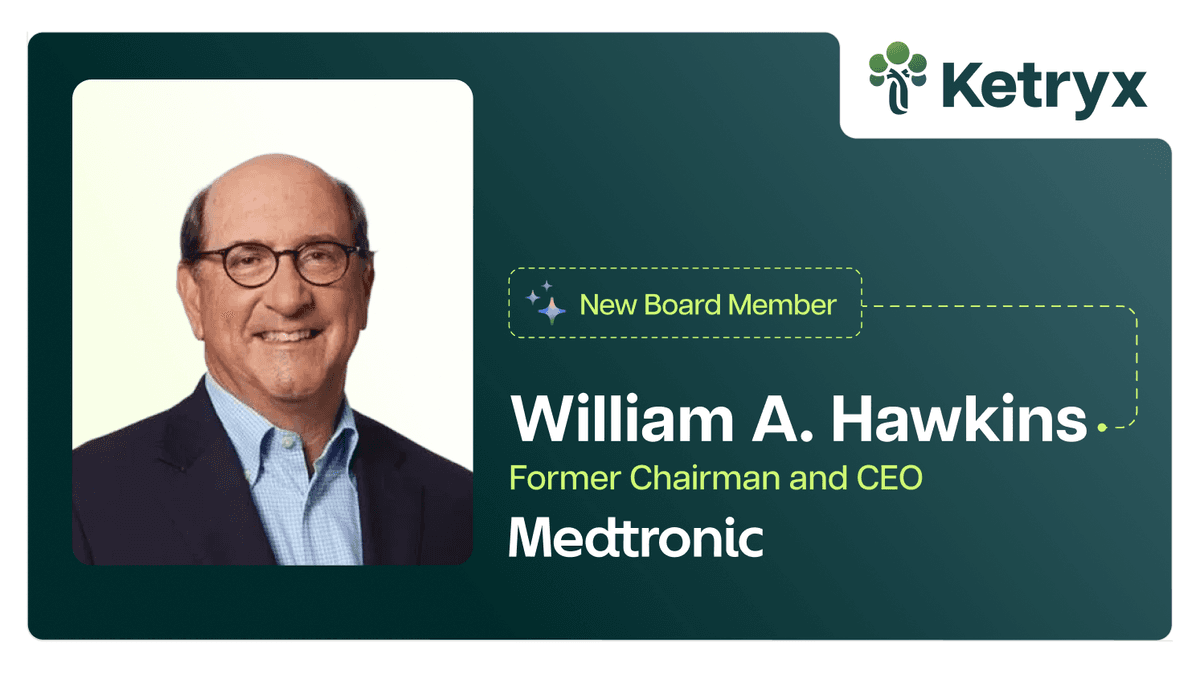
Ketryx, the agentic continuous compliance platform for safety-critical product development, announced today that William A. Hawkins, former Chairman and CEO of Medtronic, has joined its Board of Directors. Hawkins also participated in the company’s Series B financing, underscoring his commitment to the firm’s mission.
Ketryx helps companies in safety-critical industries—including medical devices, pharmaceuticals, and robotics—accelerate product development by automatically generating compliant documentation, maintaining continuous traceability, and enabling safe and verifiable AI at scale within the tools teams already use. The addition of Hawkins, who led Medtronic from 2007 to 2011 and oversaw its growth into the world’s largest medical device company, brings deep industry expertise to Ketryx as it tackles the bottleneck of integrating AI into regulated environments.
“Bill’s leadership at Medtronic and his understanding of the regulatory landscape make him an invaluable partner as we scale,” said a Ketryx spokesperson. “His insight will help us navigate the complexities of bringing AI-driven compliance to life sciences.”
The appointment comes at a critical time when the life sciences industry faces mounting pressure to adopt AI while satisfying stringent regulatory requirements. Traditional development processes are manual and error-prone, often leading to delays in bringing life-saving products to market. Ketryx’s platform overlays existing tools to automate documentation, create traceability, and accelerate release cycles without disrupting workflows. Its AI agents reduce manual work by up to 90 percent and help teams identify and close compliance gaps, improving both speed and quality across the product lifecycle.
Trusted by four of the world’s top five medical device manufacturers, Ketryx is positioned to transform how safety-critical products are developed. The company’s focus on “agentic continuous compliance” means that AI systems can autonomously generate and maintain the documentation required for regulatory approval, a process that historically consumes vast resources. By automating these tasks, Ketryx aims to reduce the time-to-market for new devices and treatments while ensuring safety and efficacy.
Hawkins’ involvement signals confidence in Ketryx’s approach and may attract further investment from the medical technology sector. The implications for the industry are significant: faster innovation cycles could lead to quicker patient access to advanced therapies, while rigorous compliance ensures that safety remains paramount. For pharmaceutical and robotics firms facing similar challenges, Ketryx’s platform offers a template for integrating AI without compromising regulatory standards.
For more information, visit www.ketryx.com.
