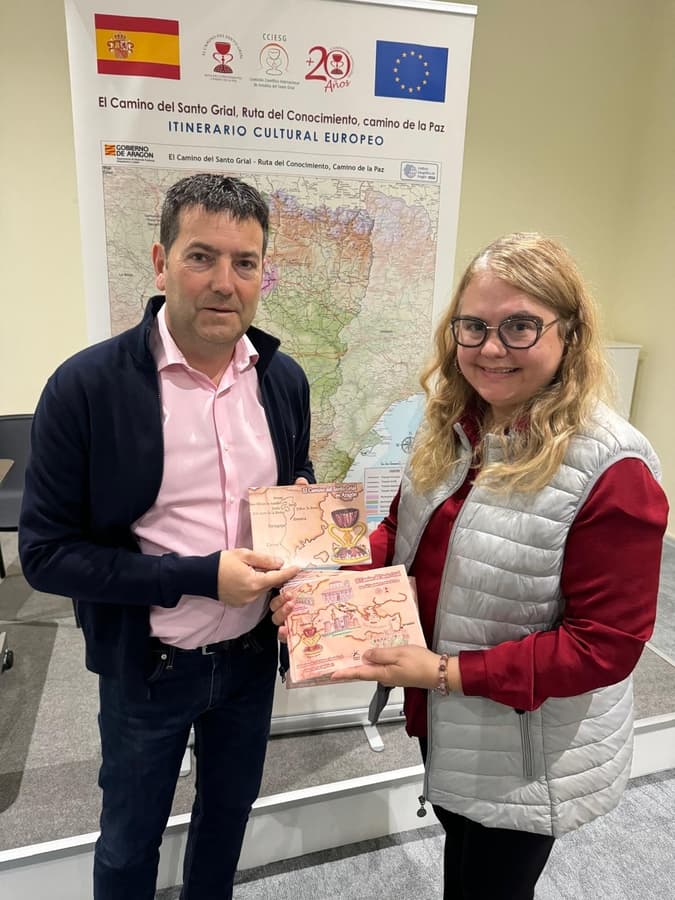
In a significant development for cultural tourism and historical preservation, Zaragoza's Central Region in Spain recently hosted the first-ever 'Jornadas del Camino del Santo Grial' (Days of the Way of the Holy Grail) event. This initiative, which took place over several weekends in November 2024, marks a crucial step towards the certification of the 'Camino del Santo Grial' (Way of the Holy Grail) as a European Cultural Itinerary for 2024-2025.
The event, organized by Zaragoza's Central Region, the Cultural Association of the Camino del Santo Grial, and research experts, brought together municipal officials, council members, and history enthusiasts. It featured a series of guided tours and lectures across multiple municipalities, exploring the spiritual and cultural legacy of the Holy Grail and its historical route through the region.
Dr. Ana Mafé García, a world-renowned expert in the proto-history of the Holy Grail, and Dr. Jean-Philippe Sendat, a member of the International Scientific Committee on Holy Grail Studies, were among the notable participants who shared their expertise during the event. Their contributions underscored the academic and cultural significance of the initiative.
The importance of this event extends beyond local interest, potentially impacting cultural tourism and historical research on a global scale. By highlighting the 'Camino del Santo Grial', the event aims to preserve and promote a significant piece of European cultural heritage. The route's potential certification as a European Cultural Itinerary could lead to increased international recognition and tourism, benefiting local economies along the path.
Several municipalities along the route, including Zuera, Villanueva de Gállego, María de Huerva, Cadrete, Cuarte de Huerva, and Botorrita, played host to various activities. Each town showcased its unique historical and cultural contributions to the Grail's narrative, from Gothic-Mudéjar architecture to archaeological sites dating back to the Roman era.
The event also explored the intersection of history, spirituality, and popular culture. Lectures covered topics ranging from the oral traditions surrounding the Holy Chalice to the impact of modern media, such as the Indiana Jones films, on public interest in the Grail legend. This multifaceted approach demonstrates the enduring relevance of historical narratives in contemporary society.
Dr. Mafé's lecture on the oral tradition of the Holy Chalice highlighted how local communities have preserved the Grail's legacy through generations. This emphasis on intangible cultural heritage aligns with UNESCO's efforts to safeguard such traditions, potentially opening avenues for further recognition and protection of the route's cultural significance.
The scientific approach to studying the Holy Grail, as demonstrated in lectures on sacred geometry and iconology, adds a layer of academic rigor to the cultural itinerary. This could attract researchers and scholars, further enhancing the route's educational value and international standing.
As the 'Camino del Santo Grial' progresses towards European Cultural Itinerary certification, it joins the ranks of other famous pilgrimage routes like the Camino de Santiago. This recognition could lead to improved infrastructure, preservation efforts, and cultural exchange programs along the route, benefiting both local communities and international visitors.
The success of this inaugural event sets a precedent for future cultural initiatives centered around historical routes and religious artifacts. It demonstrates how local heritage can be leveraged to create broader cultural narratives that resonate on a European and global scale, potentially inspiring similar projects in other regions.
As the 'Camino del Santo Grial' gains recognition, it not only preserves a piece of Christian history but also fosters intercultural dialogue and understanding. The route's development could serve as a model for how historical narratives can be used to promote cultural tourism, economic development, and international cooperation in the preservation of shared heritage.