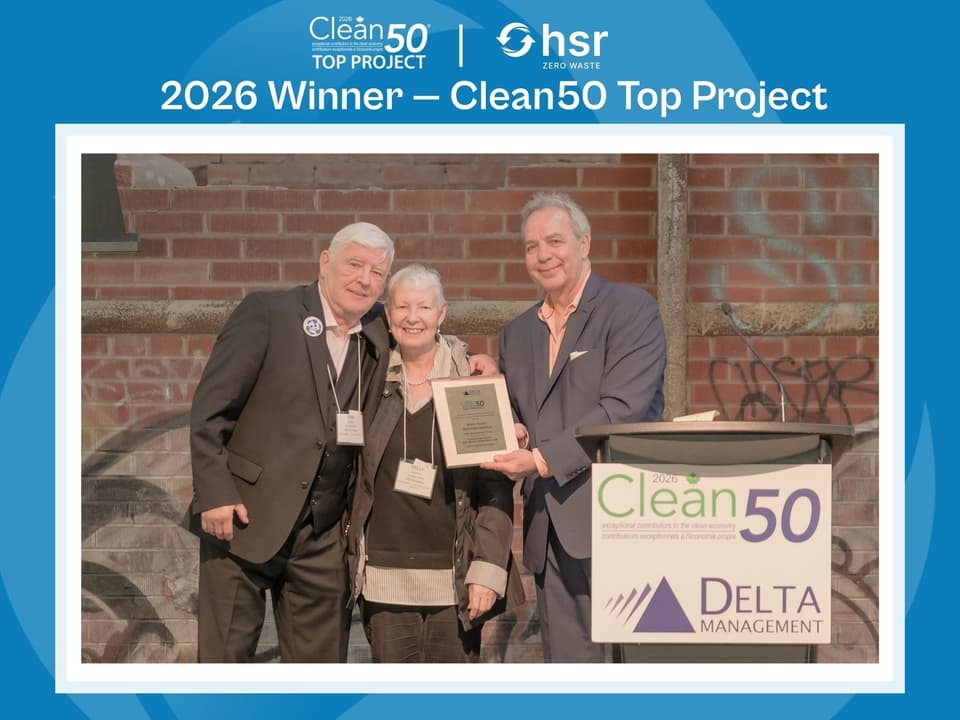
HSR Zero Waste has received the 2026 Clean50 Top Project Award for its Comprehensive Waste Management System Redesign and Implementation Project, which transformed how high-traffic facilities can transition toward zero waste operations. The project demonstrated that significant environmental performance improvements can be achieved through operational redesign and resource management rather than relying on new infrastructure or major capital investment.
Before HSR's intervention, the facility's waste diversion rate had stagnated at approximately 50 percent. The consulting firm took control of all waste streams and implemented a comprehensive program combining operational redesign, data-driven planning, and on-site engagement. The system proved that operational change alone can deliver substantial environmental impact when properly designed and implemented.
The project's methodology included conducting in-depth waste composition and equipment assessments to identify efficiency gaps, delivering internal zero waste training for operations and events staff, reconfiguring waste flows, and reallocating existing equipment to optimize processing. A key innovation was the launch of an on-site sorting system designed to recover value from materials previously treated as waste.
The results were substantial and measurable. The program boosted diversion rates to 75-90 percent on a consistent basis, representing a significant improvement from the previous plateau. In 2024 alone, the project successfully diverted over one million kilograms of material from landfill and incineration, demonstrating the scalability of the approach for large facilities.
What distinguishes HSR's methodology is its focus on integration rather than interruption. Unlike many sustainability programs that require major infrastructure upgrades, this system was designed to fit seamlessly into existing workflows, maintaining day-to-day continuity while improving efficiency. The program introduced clearer waste streams and contamination controls, which improved compliance and data accuracy across departments.
Through consistent communication, on-site training, and responsive adjustments, the implementation proceeded smoothly and collaboratively. This approach demonstrates that zero waste transformation can occur without operational disruption, making it more accessible to organizations concerned about implementation challenges.
The success of this project extends beyond a single facility. HSR's framework, which combines waste analytics, process design, and training, has been documented as a replicable model for facilities across Canada, including event venues, institutions, and commercial sites. Organizations can learn more about this approach by visiting https://www.hsrzerowaste.com.
This recognition matters because it provides a proven, practical model for organizations seeking to improve their environmental performance without substantial capital investment. The project demonstrates that operational efficiency and waste reduction can be achieved through systematic redesign rather than expensive infrastructure projects, making sustainability more accessible to a wider range of organizations.
The implications for industries and communities are significant. As municipalities and organizations face increasing pressure to meet waste reduction targets, this approach offers a cost-effective pathway to substantial improvement. The documented success provides a blueprint that can be adapted across multiple sectors, potentially accelerating waste diversion efforts nationwide.
For facility managers and sustainability officers, this project offers evidence that existing operations can be optimized to achieve dramatic improvements in waste management. The consistent 75-90 percent diversion rates achieved through this methodology represent a substantial advancement in practical sustainability implementation that maintains operational continuity while delivering environmental benefits.