

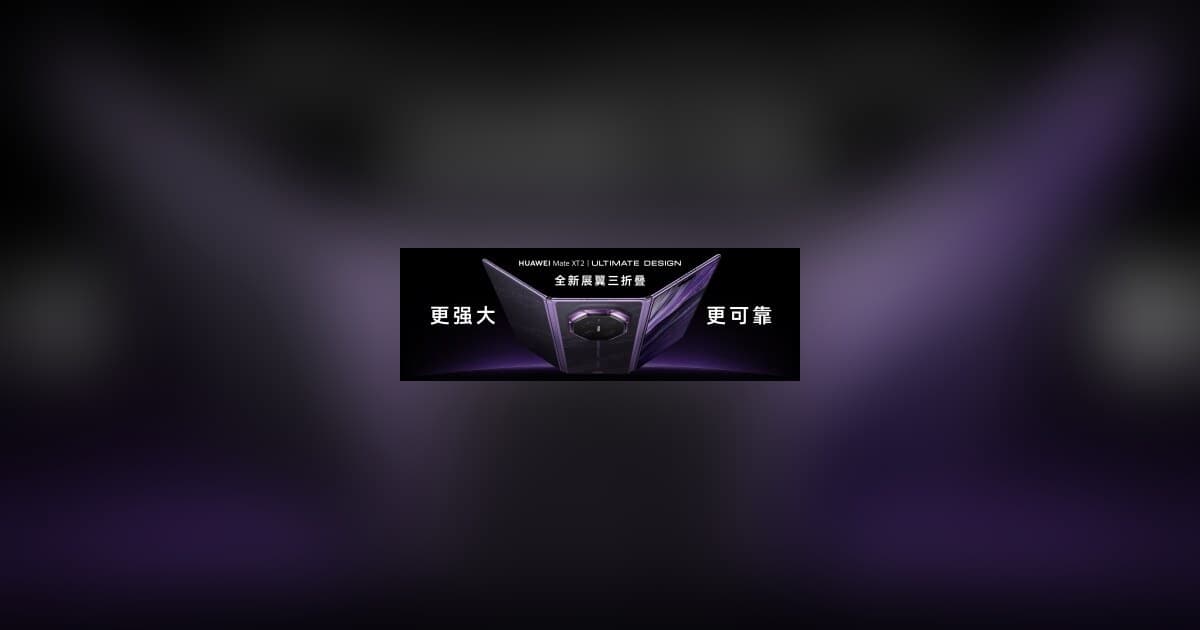
Huawei has released the HUAWEI Mate XT 2 | ULTIMATE DESIGN, a trifold smartphone that is the first to run HarmonyOS 7 and the first to feature the LogicFolding Tau (τ) chip, marking a significant breakthrough in semiconductor design. The device, launched on September 7, is the slimmest and largest foldable smartphone in the industry, according to the company.
The Mate XT 2's Kirin 9050 Pro chip, designed by Huawei's HiSilicon team, is the first to use LogicFolding technology, which employs 3D integration to stack transistors, increasing density from approximately 155 to 238 million transistors per square millimetre. This increase is equivalent to what was achieved in the previous three years using traditional geometric shrinking. The chip addresses the challenges of Moore's Law, which is believed to be reaching its physical limit. Huawei proposes the τ (Tau) Scaling Law as an alternative, measuring chip performance by time rather than size. He Tingbo, President of Huawei's HiSilicon division, unveiled this approach in May and was recently named one of the world's leading AI innovators by Time Magazine.
LogicFolding reduces the distance between transistors, which in turn reduces power consumption. Contrary to previous assumptions, stacking transistors does not increase heat; instead, LogicFolding chips run cooler per unit of work. This innovation is crucial for mobile phones and large AI clusters, where up to 80% of energy is used in moving data rather than processing it. The result is Huawei's most powerful smartphone ever.
The Mate XT 2 features a foldable wing-like form that transforms into a tablet, with a hinge that is the first of its kind. When open, the handset is just 3.5mm thick. The cover screen spans 6.5 inches, boosting the screen-to-body ratio from 86.4% to 92.8%, and offers 70% better anti-reflection. It also introduces the world-first Smart Shield Privacy Screen on a foldable, with two independent pixel sets within the 10.2-inch display at a micro-pitch of 9 μm, allowing users to switch from a wide to a narrow viewing angle while maintaining resolution.
In health tech, the Mate XT 2 is the industry's first smartphone to introduce ECG analysis. Users can hold both side frames while unfolded to capture a 30-second ECG signal, generating detailed reports to help identify Sinus Rhythm, Atrial Fibrillation, and Premature Beats.
The launch underscores Huawei's substantial R&D commitment. More than half of Huawei's employees work in R&D—over 100,000 people—and the company holds 160,000 active patents worldwide. In the first half of 2026 alone, Huawei's R&D investment exceeded RMB 121 billion, accounting for 25.94% of revenue, up 25.2% year on year. This announcement, distributed via Media OutReach Newswire, highlights Huawei's role in driving industry-changing innovation despite external restrictions.
The HUAWEI Mate XT 2 | ULTIMATE DESIGN starts at RMB 19,999 and is now available for purchase, following its official sales launch on September 12. The device's advanced features and semiconductor breakthrough could influence future smartphone design and chip manufacturing across the industry.
