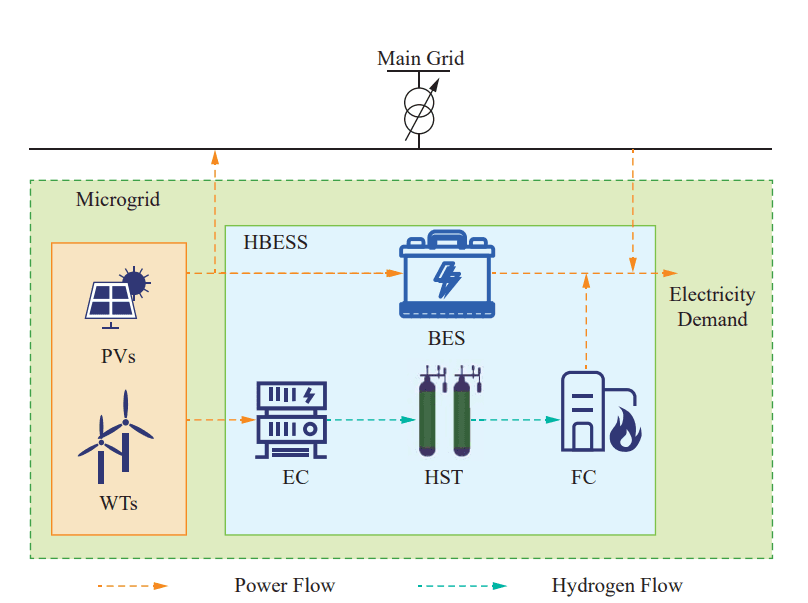
A team of researchers led by Professor Xu Zhao from The Hong Kong Polytechnic University has developed a novel approach to optimize the operation of hybrid hydrogen-battery energy storage systems (HBESS) within microgrids. This innovative model, detailed in the journal Global Energy Interconnection, addresses the critical challenge of managing energy storage and distribution in small-scale power networks, potentially revolutionizing the efficiency and cost-effectiveness of renewable energy systems.
The study introduces an adaptive robust optimization method that aims to minimize operating costs while effectively managing the state-of-charge (SoC) of battery storage. This two-stage approach first establishes hydrogen dispatch and battery SoC boundaries in the day-ahead stage, followed by intraday battery dispatch within these defined limits. The model's ability to adapt to uncertainties in energy demand and supply makes it particularly valuable for the increasingly complex landscape of renewable energy integration.
The significance of this research lies in its potential to enhance the reliability and economic viability of microgrids, which are becoming increasingly important in the global transition to sustainable energy systems. Microgrids, which can operate independently or in conjunction with the main power grid, are crucial for integrating renewable energy sources and improving energy resilience in various settings, from remote communities to urban neighborhoods.
By optimizing the use of hybrid energy storage systems, the proposed model addresses one of the key challenges in renewable energy adoption: the intermittency of sources like solar and wind power. The combination of hydrogen and battery storage offers a flexible and efficient solution to balance energy supply and demand, potentially reducing reliance on fossil fuel-based backup systems.
The researchers' use of robust optimization techniques is particularly noteworthy, as it allows the system to maintain optimal performance even in the face of uncertainties. This adaptability is crucial in real-world applications where energy demand and renewable energy generation can be highly variable and difficult to predict accurately.
Simulation results presented in the study demonstrate the model's exceptional performance efficiency and resilience. These findings suggest that the proposed system could significantly reduce operating costs for microgrid operators while maintaining a stable and reliable power supply. This has important implications for both the economic feasibility of renewable energy projects and the broader goal of reducing carbon emissions in the energy sector.
The research also highlights the growing importance of interdisciplinary approaches in addressing complex energy challenges. By combining expertise in electrical engineering, computer science, and operations research, the team has developed a solution that bridges the gap between theoretical optimization models and practical energy management systems.
As the world continues to grapple with the challenges of climate change and the need for sustainable energy solutions, research like this plays a crucial role in shaping the future of energy systems. The optimization of hybrid energy storage in microgrids could accelerate the adoption of renewable energy sources, particularly in areas where traditional grid infrastructure is lacking or unreliable.
While the study focuses on the technical aspects of energy storage optimization, its implications extend far beyond the realm of engineering. By improving the efficiency and reliability of renewable energy systems, this research contributes to broader efforts to reduce greenhouse gas emissions, enhance energy security, and promote sustainable development.
As policymakers and industry leaders seek innovative solutions to meet ambitious climate goals, the adaptive robust optimization approach proposed by Professor Zhao and his team offers a promising path forward. The potential for widespread application of this model in various microgrid settings could lead to significant advancements in the way we generate, store, and distribute clean energy, ultimately contributing to a more sustainable and resilient energy future.