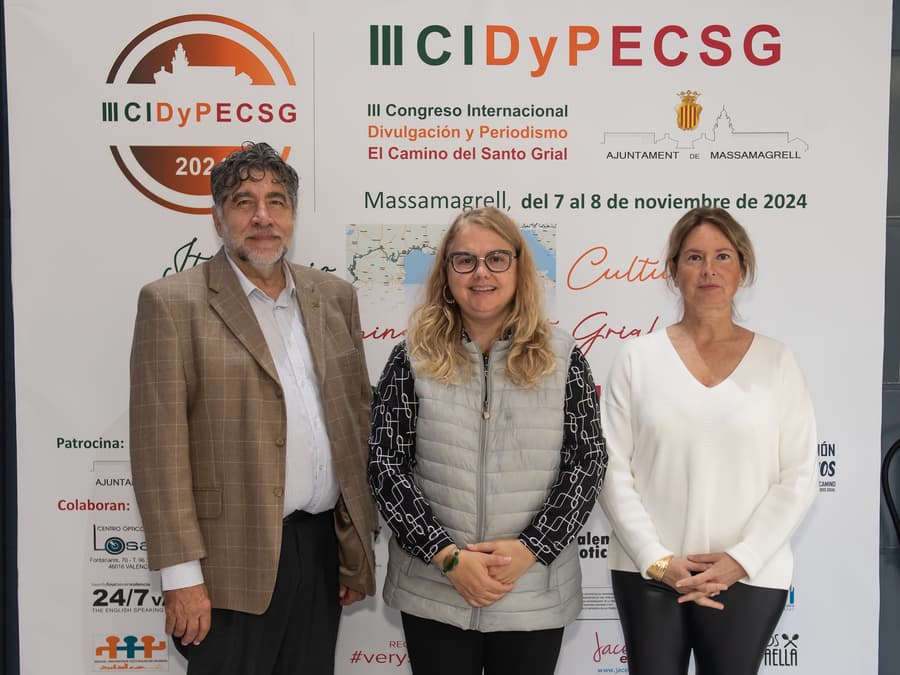
Massamagrell, Valencia recently hosted the III International Congress on Journalism and Communication: The Way of the Holy Grail (III CIDyPECSG), a two-day event that gathered experts, academics, and cultural enthusiasts to explore the historical, cultural, and social significance of the Holy Grail. The congress, which took place against the backdrop of recent tragic floods in Valencia, provided a platform for discussions on the Holy Grail's journey through Spain, France, and Italy, while also addressing contemporary issues in cultural tourism and heritage preservation.
The event began with a solemn tribute to the victims of the recent floods in Valencia, setting a tone of reflection and responsibility. Local and international authorities, including Pilar Peris Barres, Mayoress of Massamagrell, and Dr. Ana Mafé García, President of the International Association Cultural Itinerary of the Holy Grail, opened the congress, emphasizing its importance in bridging past traditions with future innovations.
The first day of the congress focused on the Mediterranean connection of the Holy Grail Route, with experts from Spain, France, and Italy leading discussions on cultural heritage, route signage, and the integration of tradition with innovation. Presentations covered topics such as the evolution of the Holy Grail route as a European Cultural Itinerary and the positive experiences from other pilgrimage networks like the Way of St. James. The day also saw the announcement of the 1st International Conference 'Universities and Cultural Routes' scheduled for November 2024 in Santiago de Compostela, highlighting the growing academic interest in cultural routes.
A significant portion of the discussions centered on the role of public institutions in preserving cultural heritage and the importance of cooperation between municipalities, businesses, and media in protecting the Grail's legacy. The congress also addressed the engagement of European youth through educational and cultural exchanges, with representatives discussing opportunities offered by programs like Erasmus+.
The second day of the congress shifted focus to sustainable tourism and digital innovation. Dr. Fernando Molina Pons presented a model for "circular and regenerative" tourism, emphasizing the potential of identity-based cultural routes as a means of sustainable tourism development. The day's sessions explored how audiovisual media can amplify the Holy Grail's cultural relevance and the role of sacred geometry in shaping Europe's cultural legacy.
A key theme throughout the congress was the intersection of cultural heritage preservation and innovative tourism practices. Experts discussed strategies for identity-based cultural tourism routes, emphasizing the importance of circular and regenerative practices in the tourism industry. The event also explored digital communication tools in cultural tourism, with experts sharing strategies to promote the Holy Grail Route through data analysis and storytelling.
The congress concluded with a vision for the future, including plans to consolidate a network of regenerative and solidarity-driven intelligent routes, uniting the Holy Grail Route with other European Cultural Itineraries. A proposal to activate a joint technical office to validate and enhance metrics of social, economic, and environmental impact for municipalities along the routes was also put forward.
This international gathering underscored the significance of historical routes like the Way of the Holy Grail as dynamic tools for economic regeneration, cultural exchange, and sustainable tourism. By bringing together diverse perspectives from academia, tourism, and cultural sectors, the congress highlighted the potential of such routes to inspire future generations while preserving valuable cultural heritage. The event's focus on sustainability and innovation in tourism practices reflects a growing awareness of the need to balance cultural preservation with economic development and environmental responsibility.