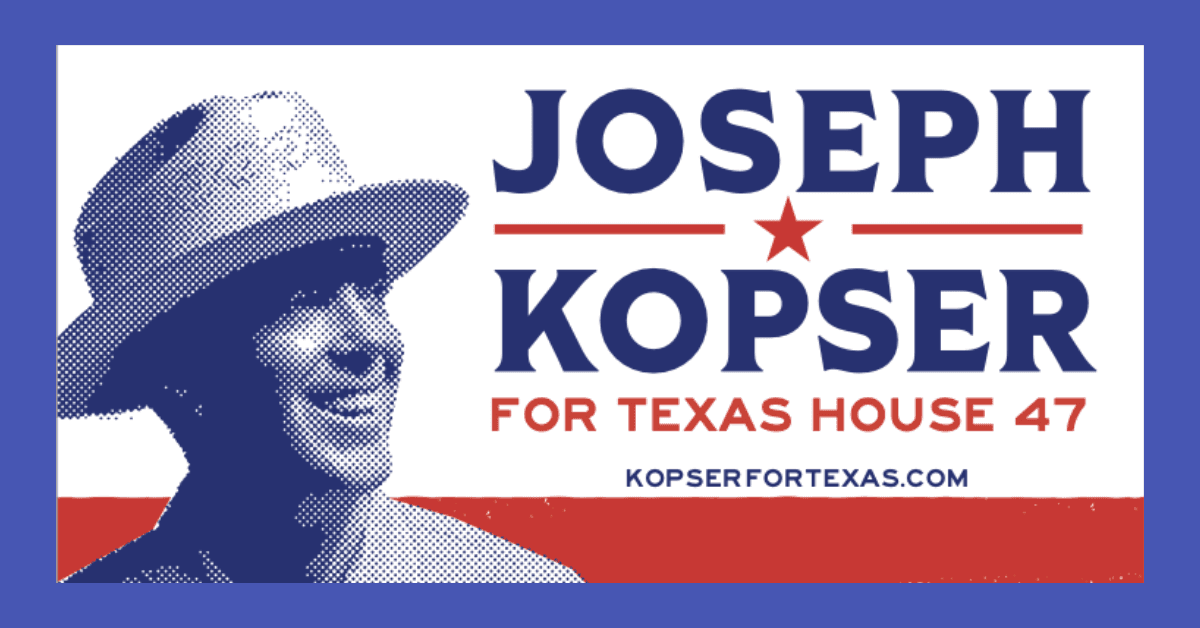
The Kopser for Texas campaign announced it has contacted more than 18,000 unregistered, likely voters who recently moved to Travis County as part of a proactive effort to strengthen civic participation and expand access to the democratic process. The outreach focused on Texans who are eligible to vote but had not yet registered, with the sole purpose of increasing participation in local and state elections.
"For too long, our political system has accepted low participation as normal," said Joseph Kopser, candidate for Texas House District 47. "We believe democracy works best when more people are engaged—not fewer." This initiative represents a significant departure from conventional political strategies that typically focus on mobilizing existing voters rather than expanding the electorate.
For the past seven years, Kopser has led USTomorrow, an organization dedicated to reinvigorating disengaged and disenfranchised voters through education, dialogue, and civic awareness. In a recent USTomorrow piece, Kopser highlighted March Matters, a non-partisan initiative focused on educating voters about the outsized impact of primary elections. The campaign's approach reflects a broader philosophy that democratic health depends on active participation rather than passive observation.
"While it may be unconventional in modern politics, we set out to expand the voter base—period," Kopser said. "The recent upset victory of political outsider and Democrat Taylor Rehmet shows what happens when voters register, show up, and motivate their friends. When people participate, anything is possible." This reference to Rehmet's victory demonstrates how voter registration efforts can translate into tangible electoral outcomes that challenge established political dynamics.
In addition to voter registration outreach, Kopser for Texas is deploying relational organizing strategies using the Reach App, a tool pioneered in Texas by Blue Action Democrats. Relational organizing empowers supporters to engage friends, family members, and neighbors—leveraging trusted relationships rather than impersonal political messaging. This approach recognizes that personal connections often prove more effective than traditional campaign tactics in motivating civic participation.
"Registering more voters, combining that effort with relational organizing, and using tools like the Reach App alongside traditional campaign strategies will turn out more voters," Kopser added. "And that's always a good thing for democracy." The campaign's methodology represents an integrated approach that combines technology with human connection to address declining voter participation rates.
Kopser for Texas emphasized that expanding participation is not a partisan goal, but a civic one—aimed at ensuring that Texas elections reflect the voices of the communities they serve. This distinction matters because it positions voter engagement as a fundamental democratic value rather than a tactical advantage for any particular political party. The campaign's efforts in Travis County could serve as a model for other regions seeking to address voter apathy and strengthen democratic institutions through proactive outreach to unregistered citizens.