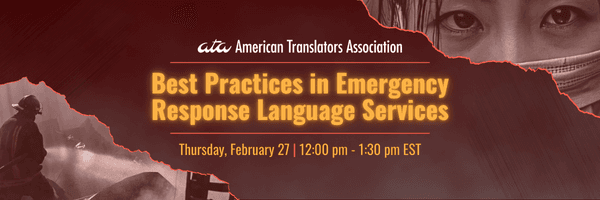
The American Translators Association (ATA) is set to convene a critical discussion on emergency response language services, featuring experts who have navigated complex communication challenges during some of the most intense scenarios imaginable. The free 90-minute virtual roundtable will bring together professionals from emergency response, law enforcement, healthcare, education, and linguistic services to address the vital role of clear communication during crises.
The event highlights the profound importance of linguistic and cultural competence when lives are at stake. Panelists including Rhode Thomas, a seasoned interpreter who has worked during Hurricane Helene and after school shootings, and Aaron Kubey, a FEMA employee and certified Deaf Interpreter, will share insights into bridging critical communication gaps during emergencies.
Participants will explore key challenges faced by language professionals in high-pressure environments, examining how effective interpretation and translation can mean the difference between chaos and resolution. The discussion will focus on practical strategies for maintaining composure, ensuring accuracy, and building trust across diverse communities during emergency scenarios.
The roundtable will address multiple critical dimensions of emergency communication, including the role of cultural sensitivity, technological tools, and human expertise. Experts will discuss scenarios ranging from natural disasters and active shooter incidents to international crises, providing attendees with actionable insights into best practices for emergency language services.
Distinguished panelists represent a wide spectrum of professional experiences, including Sergeant Clarence E. Stokes III, a 32-year law enforcement veteran, and Marjorie Kouns, a multilingual 911 dispatcher. Their collective expertise underscores the multifaceted nature of crisis communication and the critical need for specialized linguistic skills.
By bringing together professionals from various sectors, the ATA aims to enhance understanding of how language services can be pivotal in emergency response. The event represents a significant opportunity for practitioners to learn, share experiences, and develop strategies that could potentially save lives in critical situations.