

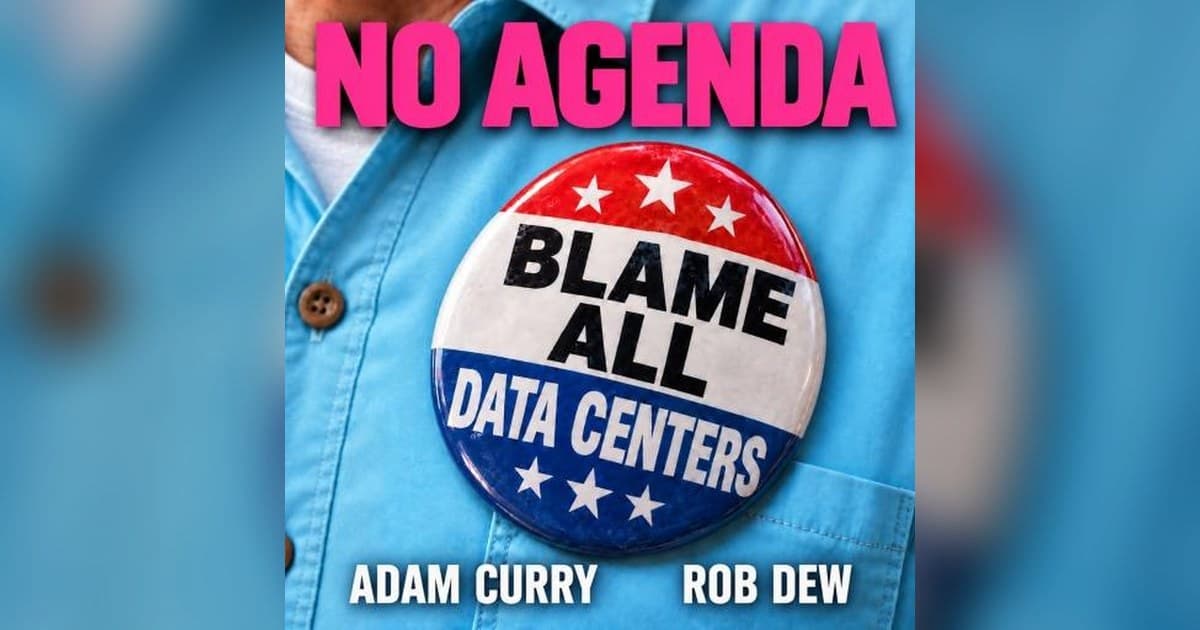
The latest episode of the No Agenda Show, titled "Immune Amnesia," published on October 4, 2026, delivers a sweeping media deconstruction that underscores the escalating complexity of the modern news landscape. Host Adam Curry, broadcasting from the Texas Hill Country, is joined by returning guest co-host Rob Dew (Sir Dusifer) for a multi-hour analysis that spans technology, public health, and civil unrest, challenging listeners to question dominant narratives.
Central to the episode is the accelerating displacement of commercial software by AI agents—a shift with profound implications for the tech industry and employment. Curry and Dew explore this "death of software" thesis through concrete examples, including a reverse-engineered version of Call of Duty: Modern Warfare 2 running Halo assets, and Dew's own experiment building a donation-spreadsheet tool that replaced Microsoft Excel in his workflow. Curry also details his new podcastindexrobot.com MCP server, built on the open Podcast Index he co-owns with Dave Jones, demonstrating how an agent can strip six minutes of dynamically inserted ads from Ed Zitron's Better Offline. These developments signal a future where AI-driven automation could upend traditional software markets and advertising models, raising questions about job displacement and economic disruption.
The hosts also scrutinize the mysterious FlyDubai Boeing 737 MAX 8 incident, incorporating pilot simulator analysis from Erin Burnett's CNN segment and expressing skepticism over the 20,000-foot dive narrative. This coverage highlights the importance of independent verification in aviation reporting, especially given Boeing's troubled history with the MAX line. Meanwhile, a pneumonic plague death in Russia's Irkutsk region and a measles resurgence in Pennsylvania—featuring immunologist Michael Mina and the concept of "immune amnesia"—underscore ongoing global health vulnerabilities. The measles outbreak, in particular, serves as a reminder of the consequences of declining vaccination rates and the need for robust public health infrastructure.
Violent school protests across France, reported by GB News and France 24, with burning schools, barricades, and "outsiders" in Paris suburbs, point to deepening social fractures. The Cornell fraternity allegations, drawing commentary from AOC, Sonny Hostin, and Letitia James, further illustrate how cultural and legal battles are intensifying. Additionally, Meta's new Muse AI agent, Mark Zuckerberg's Charm device, and Airbnb CEO Brian Chesky's remarks on Silicon Valley's disconnection from the public reveal a growing rift between tech leaders and society.
Curry's response to a Gen Z TikToker warning about AI-driven reverse engineering of banks, satellites, and encrypted systems captures the episode's tone: "I'm afraid we've opened Pandora's box, but humanity hasn't even recognized it yet because we've been too excited holding it. And now it's become the mark of the beast, the birthing pains of the rapture, the second coming of the nuclear bomb. But instead of fission, it's just text." This apocalyptic framing is balanced by historical context, including a 1999 David Bowie interview predicting the internet as "an alien life form," and a 1994 Today Show clip of Katie Couric asking, "What is internet, anyway?" along with Gina Raimondo's warning of "rioting in the streets" from AI job displacement.
For listeners, Episode 1909 offers a critical lens on how media frames stories, repeats narratives, and ignores uncomfortable truths. As AI continues to reshape economies and societies, the episode's value lies in its call to remain vigilant and informed, recognizing that the forces at play—from technological disruption to social upheaval—demand active engagement rather than passive consumption. The episode is available now wherever podcasts are heard.
