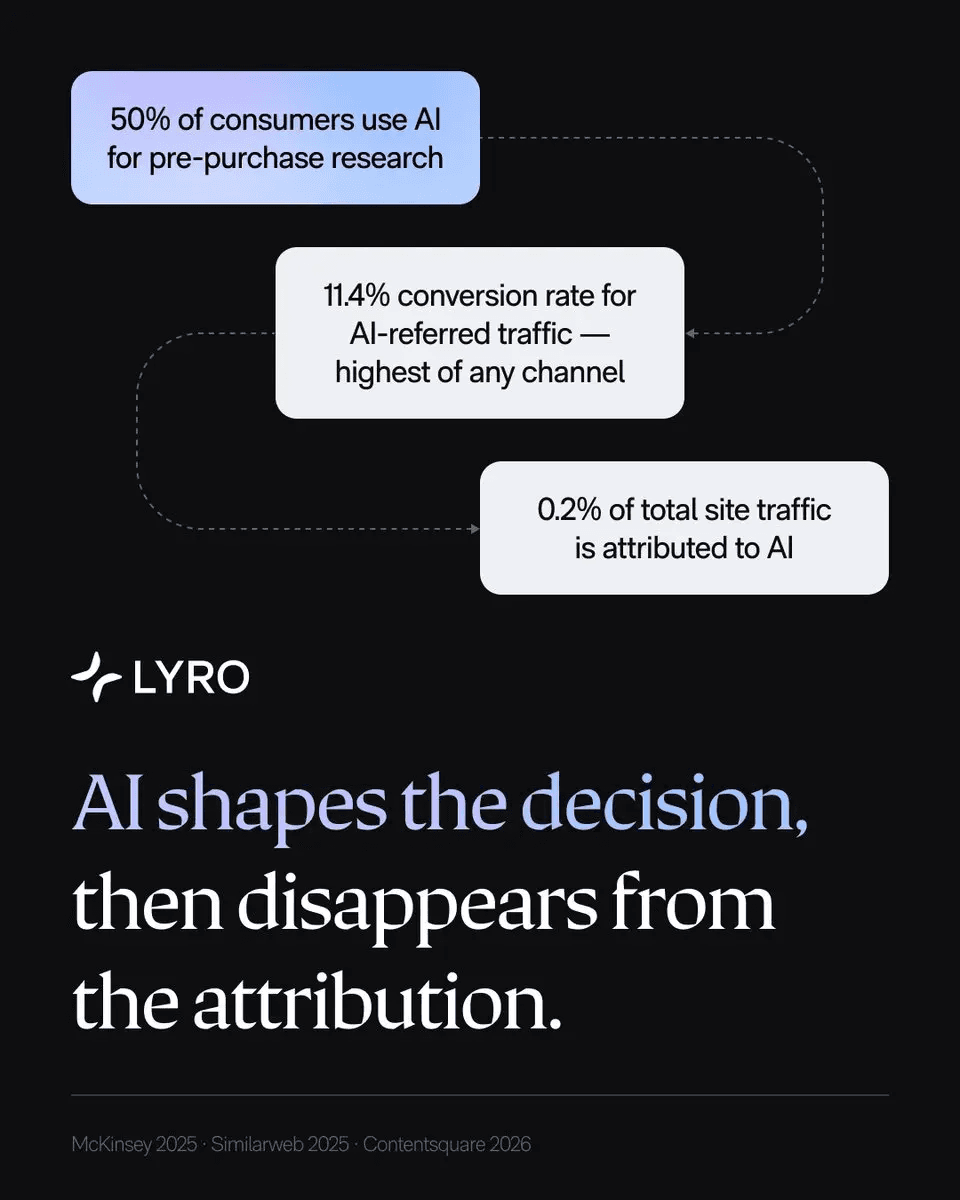
New research from Tidio exposes a critical measurement gap in digital commerce, revealing that artificial intelligence influences approximately half of consumer purchase decisions while receiving credit for less than 1% of retail web traffic. This discrepancy, termed the 'dark AI' gap, suggests current analytics tools are failing to capture the true scale of AI's role in the consumer journey, with significant implications for marketing strategy and revenue forecasting.
The findings are based on contrasting data points from leading industry sources. According to McKinsey, half of consumers now rely on AI as their primary or preferred source for product research. However, Contentsquare's analysis of actual retail web traffic places AI-referred sessions at just 0.2% of total visits. Both figures are accurate according to Tidio's analysis, indicating that AI shapes purchase decisions at a scale current attribution models cannot capture.
Further evidence of AI's hidden influence comes from Similarweb data showing ChatGPT-referred U.S. retail sessions convert at 11.4%, the highest rate of any measured channel. This implies that the small percentage of tagged AI referrals reflects high-intent traffic from a much larger pool of AI-influenced consumer journeys that remain invisible to traditional tracking methods.
The financial stakes of this measurement gap are substantial. McKinsey projects $750 billion in U.S. revenue will flow through AI-powered search by 2028, with brands that fail to prepare risking 20–50% of their traditional search traffic. Morgan Stanley estimates AI agents will influence $190–$385 billion in U.S. e-commerce spending by 2030. These projections suggest that businesses relying solely on conventional web analytics may be dramatically underestimating AI's current and future impact on their revenue streams.
The research highlights the growing importance of platforms like Tidio that integrate AI capabilities directly into customer service functions. Tidio's AI agent, Lyro, demonstrates how AI can operate across multiple touchpoints, resolving an average of 67% of incoming customer service tickets while maintaining high satisfaction scores. More information about Lyro's capabilities is available at https://www.getlyro.ai.
For retail businesses, the implications are clear: traditional attribution models are becoming increasingly inadequate for understanding modern consumer behavior. As AI tools like chatbots, virtual assistants, and AI-powered search become more integrated into daily life, their influence often occurs before consumers ever reach a brand's website, creating a blind spot in marketing analytics. Companies that fail to develop new measurement frameworks for this 'dark AI' activity risk misallocating marketing resources and underestimating competitive threats from AI-native shopping experiences.
The research suggests that businesses must look beyond conventional web traffic metrics to understand AI's true influence. This may involve developing new tracking methodologies, investing in AI-integrated customer service platforms, and re-evaluating how they measure marketing channel effectiveness in an increasingly AI-driven commerce landscape.