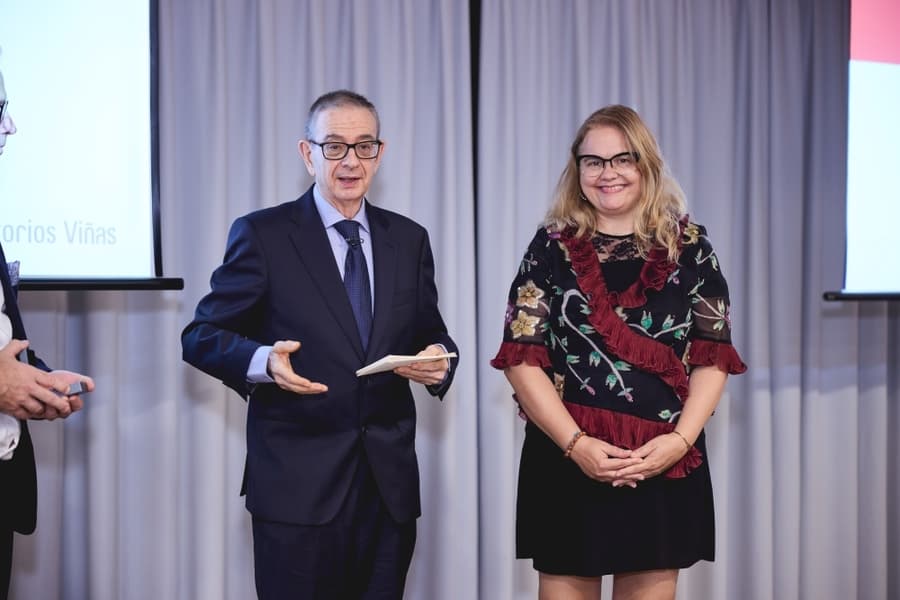
In a significant development for religious and historical studies, Dr. Ana Mafé has received recognition for her scientific demonstration of the authenticity of Valencia's Holy Chalice as the legendary Holy Grail. This acknowledgment, sponsored by Laboratorios Viñas, underscores the rigorous methodology employed by Dr. Mafé in establishing that the Chalice meets the art historical criteria to be considered one of history's most enigmatic and sought-after relics.
The recognition ceremony, held in Valencia, Spain, brought together descendants of notable Valencian cultural figures, emphasizing the enduring impact of cultural heritage across generations. Mariano Viñas, CEO and Vice President of Laboratorios Viñas, presided over the event, which not only honored Dr. Mafé's work but also celebrated the deep-rooted connections between the Viñas family and Valencia's rich cultural landscape.
Dr. Mafé's research represents a significant stride in the field of historical and religious artifact authentication. By applying scientific methods to verify the Chalice's authenticity, her work bridges the gap between legend and empirical evidence. This development has far-reaching implications for religious studies, archaeology, and cultural heritage preservation, potentially reshaping our understanding of early Christian history and the material culture associated with it.
The validation of Valencia's Holy Chalice as the authentic Holy Grail could have profound effects on religious tourism and cultural preservation efforts in the region. It may attract increased scholarly attention, pilgrims, and tourists, potentially boosting the local economy while also raising new challenges in artifact preservation and public access management.
Furthermore, this recognition highlights the importance of interdisciplinary approaches in historical research. Dr. Mafé's work demonstrates how modern scientific methods can be applied to ancient artifacts, offering new insights into their origins and significance. This methodology could set a precedent for future investigations of other historically significant relics and artifacts worldwide.
The event also served as a reminder of the interconnectedness of cultural figures across time. By bringing together descendants of renowned Valencian artists, writers, and performers, Laboratorios Viñas emphasized the importance of preserving and celebrating cultural legacies. This intergenerational approach to cultural heritage offers a model for how historical narratives can be maintained and enriched over time.
The recognition of Dr. Mafé's work comes at a time when the authenticity of historical artifacts is increasingly scrutinized. Her research provides a robust scientific foundation for claims about the Holy Chalice, potentially influencing how other historical relics are studied and authenticated in the future. This could lead to a reevaluation of other artifacts of religious and historical significance, sparking new debates and investigations in the field.
As the world grapples with questions of cultural identity and heritage preservation, the validation of Valencia's Holy Chalice as the Holy Grail serves as a powerful reminder of the enduring fascination with religious relics and their place in both faith and history. It underscores the potential for scientific inquiry to shed new light on age-old questions, bridging the gap between faith, tradition, and empirical evidence.
The implications of this recognition extend beyond academia and religion, touching on issues of cultural diplomacy and international cooperation in heritage preservation. As the Holy Grail holds significance across various cultures and traditions, the scientific validation of its authenticity could foster dialogue and collaboration among different nations and religious groups interested in its history and symbolism.
In conclusion, Dr. Ana Mafé's recognition for her work on Valencia's Holy Chalice marks a significant moment in the intersection of science, history, and cultural heritage. It not only validates a piece of religious history but also sets a new standard for the scientific study of historical artifacts. As this research gains wider recognition, it may inspire a new wave of interdisciplinary studies, encouraging collaboration between historians, scientists, and cultural preservationists in unraveling the mysteries of our shared human heritage.