

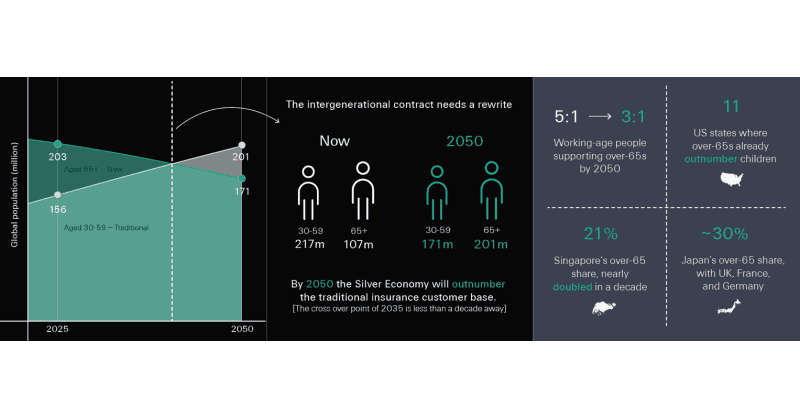
Swiss Re Life & Health CEO Paul Murray has issued a stark warning: within the next ten years, many societies will reach a demographic tipping point where the population aged over 65 will outnumber those aged 30-59, the traditional bedrock of the life and pensions system. In an op-ed published for World Population Day, Murray argues that this shift forces a fundamental rethinking of the intergenerational contract—how societies provide care and financial security for later life.
Murray points to demographic evidence already visible across major economies. In the US, adults aged 65 and over outnumber children in 11 states. Singapore's over-65 population has nearly doubled in a decade to 21%, Japan is approaching 30%, and the UK, France, and Germany are not far behind. While these numbers are well-known, Murray says their meaning is not yet fully reflected in the insurance industry's product strategy.
The tipping point is more than a statistical curiosity, he writes. It will be experienced through decisions about retirement, funding care, and how much financial burden falls on the state, families, or the individual. The arithmetic underpinning the current system is breaking: globally, the ratio of working-age people financially supporting each person over 65 is projected to fall from around five-to-one in 2021 to three-to-one by 2050. Murray calls this a crisis of design, not demographics. "Our systems were built for shorter lives and larger workforces, and they haven't been rebuilt for the world we are actually entering."
Murray believes the industry has less than a decade to develop products that older consumers and their families will need. Recent Swiss Re consumer research in France and Germany revealed that people think about later life in terms of practical outcomes: staying independent, being resilient when health shocks hit, and not becoming a burden to their children. The industry has spent decades optimizing for wealth accumulation and income protection during working years; ageing societies demand the same rigor for what happens after.
Murray highlights several existing solutions that point the way forward. Senior health products in Asia are closing a real gap: the median age of cancer diagnosis is 67, yet many critical illness policies expire before retirement. Dedicated senior cancer products can reduce out-of-pocket expenses and stress on public healthcare. Long-term care in France has seen success with private solutions alongside public provision, with over 1.4 million people covered by private long-term care insurance. Deferred annuities offer a third path, combining flexibility today with guaranteed income later, transforming longevity from an individual financial risk into one that can be shared more broadly.
These solutions, Murray argues, are pieces of the same puzzle. Each expands the circle of support around the individual, helping families carry less burden and complementing state safety nets. "That is what the next evolution of the intergenerational contract looks like in practice," he writes.
Murray concludes that ageing societies are one of humanity's great achievements, but if products and institutions remain built for a demographic reality that no longer exists, that achievement becomes a liability. "We have a decade to close that gap. Let's treat it as a product-development window, not a deadline."
