

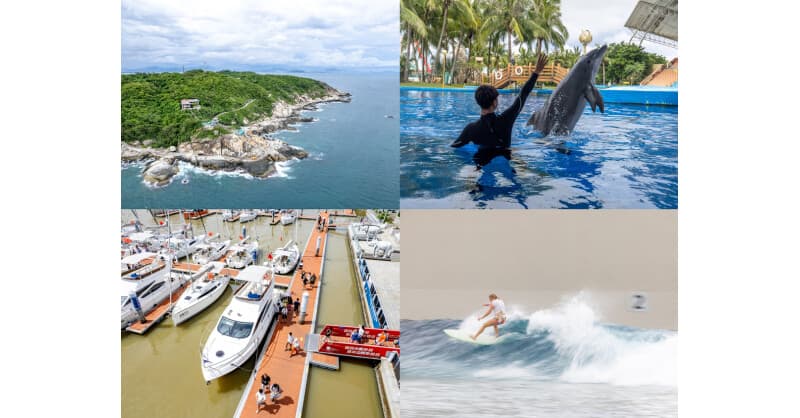
Hainan Province is rapidly transforming its coastal resources into a thriving ocean economy, as evidenced by a recent tour by international journalists from nine major media outlets. The delegation, representing countries including the United States, France, Türkiye, Spain, and the Republic of Korea, explored the region's marine cultural tourism, ecological conservation, and innovative consumer models across cities like Haikou, Wanning, Lingshui, and Sanya. Their four-day visit underscored how the Hainan Free Trade Port (FTP) is leveraging policy dividends to fuel unprecedented growth in the tourism sector.
In the first half of this year, Hainan recorded over 1 million inbound visits, a year-on-year increase of 48.8%, signaling robust momentum for the FTP's tourism industry. This surge is attributed to policies such as visa-free access for citizens of 86 countries, expanded traffic rights, and offshore duty-free shopping. The province has designated 2026 as the "Marine Tourism Year," with a strategic focus on ocean-themed cultural travel, marking the first full year after island-wide special customs operations began.
The delegation witnessed firsthand the expansion of coastal sports at Wanning's Riyue Bay, a renowned world-class surfing destination attracting over 500,000 visits annually. A highlight was the nation's first Olympic-standard artificial surf pool, which uses advanced wave-making technology to simulate 23 different wave types, enabling year-round surfing regardless of natural conditions. Turkish journalist Guney Isik Ganimgil from Aydınlık newspaper remarked that Hainan's cultural tourism development has far exceeded expectations and holds immense investment potential.
Ecological conservation is a cornerstone of Hainan's development. The Hainan Ocean Paradise Resort enforces a strict no-capture policy for wild marine life, and its rescue center has rehabilitated and released over 200 rare species, including sea turtles and hawksbills. Wuzhizhou Island has pioneered an eco-tourism model, partnering with universities to develop a tropical marine ranch. By deploying artificial reefs and transplanting tens of thousands of coral colonies, the island offers visitors the chance to participate in coral transplantation, creating a virtuous cycle between conservation and tourism engagement.
The integration of culture and tourism has also revitalized traditional maritime heritage. The Danjia fishing rafts continue to enrich their authentic marine-ethnic cultural offerings, while Tianya Town, built around a century-old fishing village, has become a coastal leisure landmark with nearly a hundred boutique homestays and specialty cafés. The Sanya International Duty-Free Shopping Complex, housing over 1,000 international brands, has introduced cutting-edge "duty-free + technology" consumption scenarios. Additionally, the Sanya Yacht Tourism Center, with a complete industrial chain, recorded over 220,000 yacht outings in 2025, cementing its status as a premier destination for high-end coastal tourism.
This transformation carries significant implications for the global tourism industry and the blue economy. Hainan's model demonstrates how policy support, ecological preservation, and cultural innovation can converge to drive sustainable economic growth. As the FTP continues to open up, it offers a compelling example for other coastal regions seeking to harness their ocean resources. The surge in inbound tourism not only boosts local businesses but also positions Hainan as a key player in international travel, potentially reshaping travel patterns in the Asia-Pacific region.
For travelers, the expanded visa-free access and duty-free shopping present new opportunities for affordable, diverse experiences. For investors, the rapid growth signals a fertile ground for ventures in marine sports, eco-tourism, and luxury travel. The "ocean economy" is no longer just a concept but a tangible reality in Hainan, where every wave and coral reef contributes to a vibrant, sustainable future.
