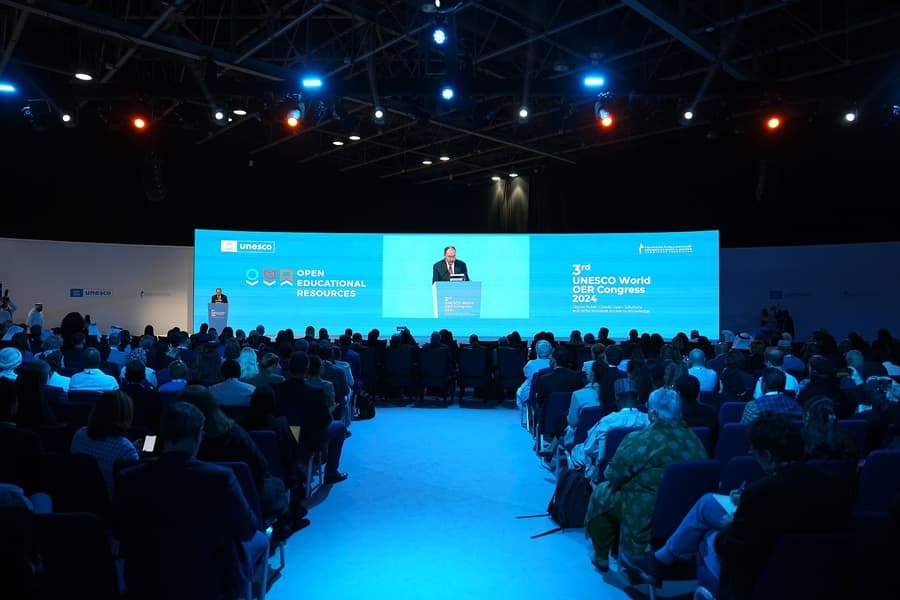
The 3rd UNESCO World Open Educational Resources (OER) Congress commenced today at the Dubai World Trade Centre, marking its first occurrence in the Arab World. The event, organized by UNESCO in collaboration with the Mohammed bin Rashid Al Maktoum Knowledge Foundation (MBRF), has attracted over 500 global participants, including ministers, academics, and private sector representatives.
Under the theme 'Digital Public Goods: Open Solutions and AI for Inclusive Access to Knowledge,' the congress aims to advance equitable and sustainable education through OER and emerging technologies. The two-day event features high-level panels, breakout sessions, and expert discussions that explore the intersection of open educational resources and artificial intelligence in addressing global educational challenges.
The opening ceremony featured addresses from key figures, including His Excellency Abdul Rahman Al Awar, Minister of Human Resources and Emiratisation and Acting Minister of Higher Education and Scientific Research of the UAE, and Dr. Tawfik Jelassi, UNESCO's Assistant Director-General for Communication and Information. Their speeches highlighted the transformative potential of OER in tackling global educational issues.
A significant focus of the congress is on policy development and implementation strategies for OER. The Ministerial Panel on Shaping the Future of Education brought together education ministers and high-ranking officials from countries such as Ghana, Burkina Faso, China, Maldives, Cambodia, and Guyana. These leaders shared their experiences and strategies for fostering innovation and inclusion through OER, providing valuable insights into diverse national approaches.
The congress also delved into the critical role of AI in advancing OER initiatives. A panel discussion on 'Harnessing OER and Generative AI for Digital Inclusion' explored how these technologies can address global challenges, including gender parity in education and language inclusion. Experts from various fields, including telecommunications and social media, contributed to this forward-looking conversation.
Breakout sessions during the event focused on implementing UNESCO's 2019 Recommendation on OER, covering crucial areas such as capacity building, policy development, quality assurance, and sustainability. These sessions emphasized inclusivity, addressing the unique needs of Africa, least developed countries, Small Island Developing States, youth, indigenous people, and other vulnerable groups.
The congress is set to conclude with the Dubai Declaration for Action on OER, which will outline concrete steps to advance inclusive and equitable quality education. This declaration is expected to have far-reaching implications for educational policies and practices worldwide.
The event showcases several success stories in OER implementation from around the globe. Cuba's Virtual Health University, Madagascar's e-learning initiatives in response to COVID-19, Malaysia's inclusive OER policy, and Morocco's national OER and Open Science strategy are among the highlighted examples. These case studies demonstrate the diverse applications and impacts of OER in different contexts, from healthcare education to primary schooling and research accessibility.
The UNESCO World OER Congress in Dubai represents a significant milestone in the global effort to leverage open educational resources and artificial intelligence for more inclusive and equitable education. By bringing together policymakers, educators, and innovators, the event facilitates the exchange of ideas and best practices that could shape the future of education worldwide. The outcomes of this congress are likely to influence educational strategies and policies across nations, potentially leading to more open, accessible, and technologically advanced learning environments for learners around the globe.